M-PESA Africa
Liners checked this listing or its product relationship to a reasonable extent. Verification is not an endorsement or product test. How verification works100% match
Mobile money transfers and payments across African markets
/Graveyard/M-Birr

Mobile money platform run with Ethiopia's microfinance institutions
Epitaph
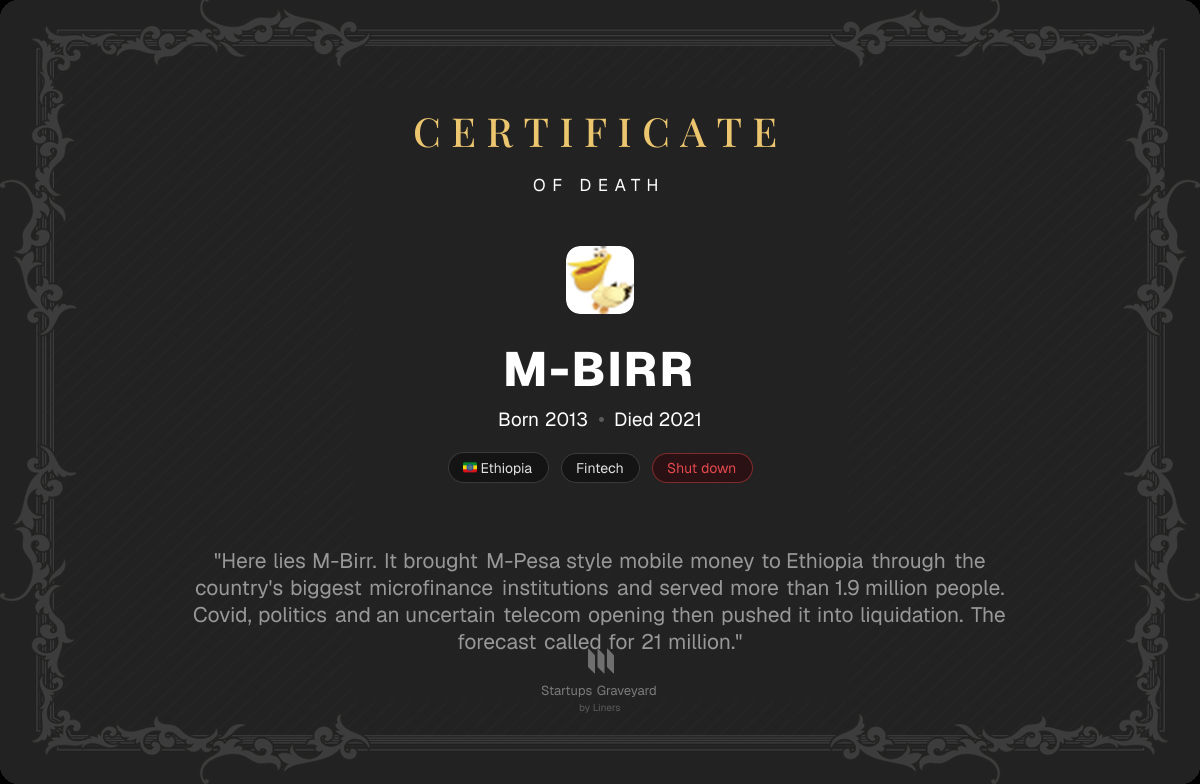
“Here lies M-Birr. It brought M-Pesa style mobile money to Ethiopia through the country's biggest microfinance institutions and served more than 1.9 million people. Covid, politics and an uncertain telecom opening then pushed it into liquidation. The forecast called for 21 million.”
M-Birr prepared pilots with five microfinance institutions on the state telecom network, with Finnfund as main investor.
The European Investment Bank approved up to EUR 4 million in equity for M-Birr Ltd.
The Currency reported that M-Birr had collapsed and was up for sale; the company went into creditors' voluntary liquidation.
M-Birr was a mobile money service built for Ethiopia. M-Birr Ltd, an Irish company that started the project in 2009, ran it through its Addis Ababa subsidiary M-Birr ICT. Five microfinance institutions covering Tigray, Amhara, Oromia, Addis Ababa and Omo signed exclusive agreements with it, and the service ran on the state telecom network so that users on basic phones could transfer money, save, top up airtime and repay loans. Pilots began around January 2013 with Finnfund as main investor.
In 2017 the European Investment Bank approved up to EUR 4 million in equity for M-Birr Ltd. The Currency reported that M-Birr became Ethiopia's leading mobile money provider and served more than 1.9 million people, with a plan projecting 21 million customers by 2026.
By September 2021 The Currency reported that M-Birr had collapsed and was up for sale. M-Birr Ltd entered a creditors' voluntary liquidation and its creditors resolved to wind up M-Birr ICT. The EIB cited the Covid-19 pandemic, the political situation in Ethiopia and uncertainty over the privatisation of the telecom and banking sectors. Sources do not document what happened to customer balances.
M-Birr set out to replicate Kenya's M-Pesa in Ethiopia, a market where only state and licensed institutions could offer financial services. Instead of applying to be a bank, it positioned itself as a technology provider: its Ethiopian subsidiary M-Birr ICT ran the platform, while five regional microfinance institutions, holding about 95% of the country's microfinance business, delivered transfers, savings, airtime top-ups, salary payments and loan repayments to their clients over basic phones.
The MFI partnership model gave it reach that a standalone startup could not have built. The Currency reported that M-Birr became the number one mobile money provider in Ethiopia and served more than 1.9 million people. It attracted Finnfund, a SIDA grant and, in 2017, up to EUR 4 million of equity from the European Investment Bank.
Full rollout depended on the National Bank of Ethiopia approving mobile and agent banking rules, and the service ran entirely on the state telecom network. Its plan to reach 21 million customers by 2026 was far ahead of the roughly 1.9 million it actually served.
According to the EIB complaints report, difficulties caused by Covid-19, the political situation in Ethiopia and uncertainty about the privatisation of telecom and banking left M-Birr ICT unable to carry its liabilities. M-Birr Ltd went into a creditors' voluntary liquidation and creditors resolved to wind up the Ethiopian subsidiary. The Currency reported the collapse in September 2021, with the business up for sale. Sources do not give the exact liquidation date or the outcome for customers.
A partner-led model can unlock a closed market, but it also ties the company's fate to regulators and partners it does not control. When a sector is about to be opened, as Ethiopia's telecom and mobile money markets were, the incumbent technology provider can lose its advantage before it reaches scale. Planning for regulatory change, not only for growth, matters as much as the customer forecast.
Was this shutdown inevitable?
Be the first to weigh in
Community opinion, not Liners' editorial conclusion.
Mobile money transfers and payments across African markets

Send money, buy airtime, and manage everyday payments

Mobile wallet for transfers, bills, and everyday payments

Send money, pay bills, and buy airtime by phone

Send, receive, and pay with mobile money across Africa
Help us give it a proper burial. Submit a shutdown and our researchers will verify it before it's laid to rest.
Submit a Shutdown