MoMo
Liners checked this listing or its product relationship to a reasonable extent. Verification is not an endorsement or product test. How verification works100% match4.7(7)
Send, receive, and pay with mobile money across Africa
/Graveyard/YUP

Société Générale's mobile money wallet for West and Central Africa
Epitaph
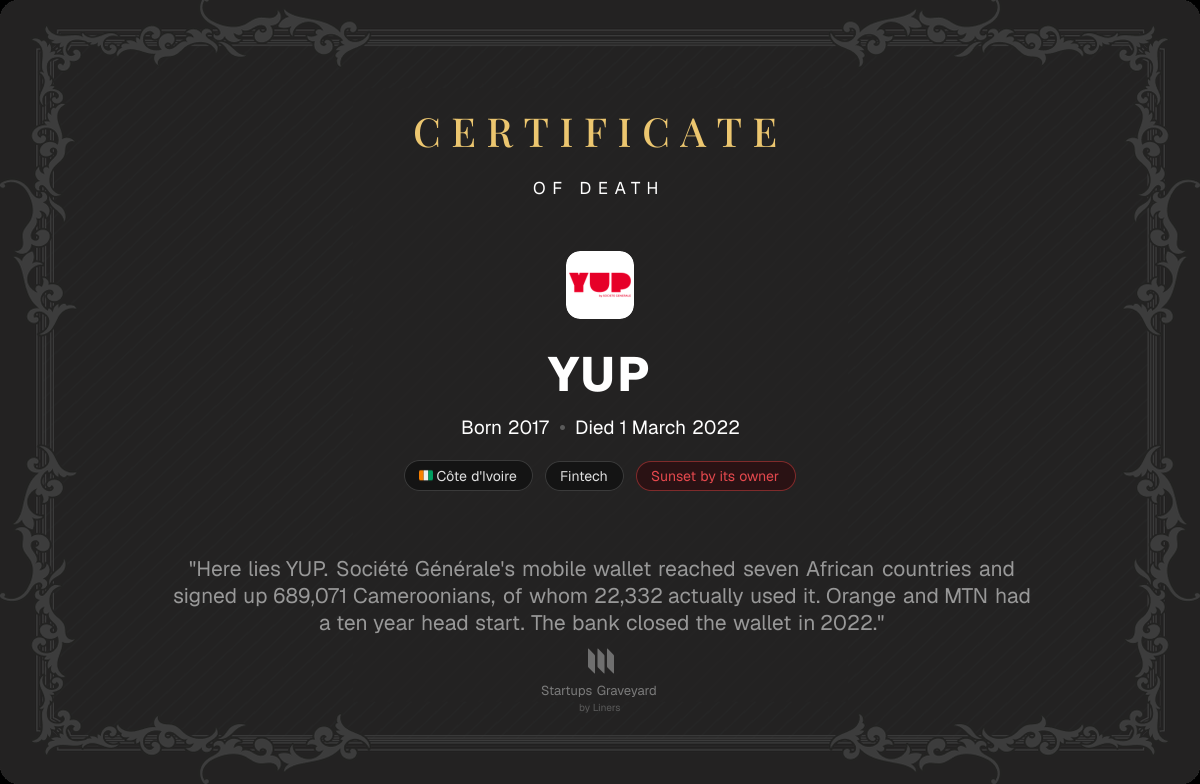
“Here lies YUP. Société Générale's mobile wallet reached seven African countries and signed up 689,071 Cameroonians, of whom 22,332 actually used it. Orange and MTN had a ten year head start. The bank closed the wallet in 2022.”
Société Générale's YUP wallet was reported live in Côte d'Ivoire and Senegal, with Ghana and Cameroon planned before the end of 2017.
Société Générale Cameroun's CEO told staff YUP would close for economic reasons; the group stopped YUP in all its markets.
An extraordinary shareholders' meeting in Douala placed YUP Cameroon into liquidation, with losses of nearly $8 million.
YUP was Société Générale's electronic wallet for Africa, launched in 2017 and powered by Tagpay. It let users deposit and withdraw cash, transfer money, pay bills and buy airtime. It started in Côte d'Ivoire and Senegal and expanded to Cameroon, Burkina Faso, Guinea, Ghana and Madagascar.
In Cameroon, YUP was owned more than 80% by Société Générale Cameroun, with the State of Cameroon and Allianz Cameroon as minority shareholders. A 2022 BEAC report cited by Business in Cameroon counted 689,071 YUP customers in Cameroon at closure, of whom only 22,332 were active, in a market of over 21 million mobile money accounts dominated by Orange and MTN.
On 1 March 2022, Société Générale Cameroun CEO Nicolas Pichou told staff that YUP would close for economic reasons, and the group stopped YUP in every market where it operated. Cameroonian customers were given three months from 15 March 2022 to withdraw or spend their balances. Shareholders put YUP Cameroon into liquidation on 29 December 2023, with losses of about $8 million.
Société Générale launched YUP in 2017 as a bank-backed alternative to telecom mobile money in Africa. Built on Tagpay, the wallet supported cash deposits and withdrawals, transfers, bill payments and airtime, with payday advances, credit, savings and international transfers planned. It began in Côte d'Ivoire and Senegal and reached seven countries, including Cameroon, Burkina Faso, Guinea, Ghana and Madagascar.
YUP had a large bank behind it and expanded quickly across Francophone and Anglophone markets. In Cameroon it signed up 689,071 customers by the time it closed, according to a 2022 BEAC report cited by Business in Cameroon.
Registrations did not turn into usage. Of those 689,071 Cameroonian accounts, only 22,332 were active, so over 96% saw little or no use. YUP was also entering a market where Orange Money and MTN Mobile Money had operated for around a decade and Orange alone reportedly held 70% of the market. ITWeb reported that YUP failed to win over a significant share of Cameroon's mobile money users.
On 1 March 2022, Société Générale Cameroun CEO Nicolas Pichou told staff that the bank could no longer continue YUP for economic reasons. The service had not become profitable or reached its targets despite efforts to grow market share and improve the customer experience. The group, after consulting its local subsidiaries, decided to stop YUP in all its markets. Cameroonian users had three months from 15 March 2022 to recover their deposits. An extraordinary shareholders' meeting in Douala placed YUP Cameroon into liquidation on 29 December 2023, and the liquidation notice put shareholder losses at nearly $8 million.
Signing up customers is not the same as becoming part of their daily payments. In mobile money, the incumbents' agent networks and existing user habits are very hard to dislodge, and a strong parent brand did not change that. A late entrant needs a clear reason for people to move their everyday transactions, and should track active use rather than registrations.
Was this shutdown inevitable?
Be the first to weigh in
Community opinion, not Liners' editorial conclusion.
Send, receive, and pay with mobile money across Africa

Mobile wallet for transfers, bills, and everyday payments

Send money, pay bills, and buy airtime by phone

Mobile money transfers and payments across African markets
Help us give it a proper burial. Submit a shutdown and our researchers will verify it before it's laid to rest.
Submit a Shutdown