Fazipay
Liners checked this listing or its product relationship to a reasonable extent. Verification is not an endorsement or product test. How verification works100% match
Agent POS network for cashouts, bills, airtime, and solar
/Graveyard/Baxi

An omichanel platform enabling commerce and digital payments.
Epitaph
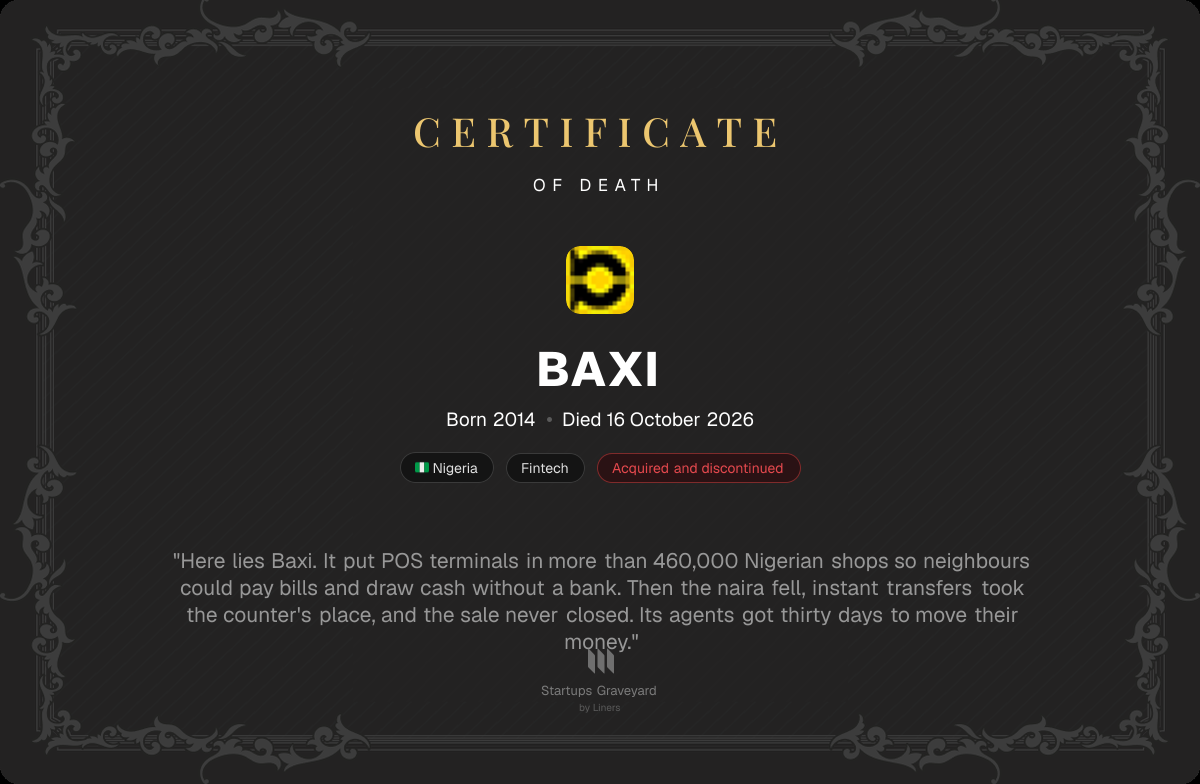
“Here lies Baxi. It put POS terminals in more than 460,000 Nigerian shops so neighbours could pay bills and draw cash without a bank. Then the naira fell, instant transfers took the counter's place, and the sale never closed. Its agents got thirty days to move their money.”
Degbola Abudu and Folu Majekodunmi start Capricorn Digital, which builds Baxi's agent and merchant network for bill payments, airtime, pay-TV, cash withdrawals and transfers
MFS Africa (now Onafriq) agrees a 100% cash acquisition of Capricorn Digital, subject to Central Bank of Nigeria approval; Baxi has about 90,000 agents
the Central Bank of Nigeria approves the deal and MFS Africa completes the acquisition; Baxi processed over $1.6 billion in transactions in 2021
Onafriq's agency-services revenue drops 56% to $13.4 million and it books a $4.56 million goodwill impairment as naira depreciation and inflation raise costs
Baxi's agent network grows to more than 460,000 agents
Onafriq's audited accounts are approved while talks to sell the Baxi agency banking business under a non-binding agreement remain unresolved; overdrafts stand at about N19.9 billion
Onafriq announces it is winding down Baxi's agent banking business, moves agents to another principal bank and gives them 30 days to transfer their funds
Baxi was the agent banking network of Capricorn Digital, a Nigerian fintech founded in 2014 by Degbola Abudu and Folu Majekodunmi. Through POS terminals and agents in shops and kiosks, it let Nigerians pay utility bills, buy airtime, data and pay-TV, withdraw cash and send money. In October 2021 MFS Africa (now Onafriq) agreed to buy Capricorn Digital outright in a cash deal; the Central Bank of Nigeria approved it and the acquisition closed in March 2022, when Baxi had more than 90,000 agents and had processed over $1.6 billion in transactions in 2021. By 2025 the network had grown past 460,000 agents.
From 2024, naira depreciation, inflation, rising operating costs, tighter competition and the spread of instant bank-to-bank transfers squeezed the business. Onafriq's agency-services revenue fell 56% between 2023 and 2024, and by mid-2026 the company was negotiating a sale of the Baxi business under a non-binding agreement that was still unresolved in July.
On 16 October 2026 Onafriq announced it was winding down Baxi's agent banking business. Agents were moved to another principal bank and given 30 days to transfer their funds. Onafriq said it would remain in Nigeria as a payments and card-issuing business.
Baxi set out to bring basic financial services to the shop counter. Capricorn Digital, founded in 2014 by Degbola Abudu and Folu Majekodunmi, built a network of agents and merchants equipped with BaxiBox POS terminals, mobile POS devices and the BaxiPay app. Through them, Nigerians could pay electricity bills, buy airtime, data and pay-TV subscriptions, withdraw cash and transfer money without walking into a bank branch.
The network scaled. When MFS Africa (now Onafriq) agreed to buy Capricorn Digital in October 2021, Baxi had about 90,000 agents, and it processed more than $1.6 billion in transactions that year. Abudu described the 100% cash deal as Nigeria's second-largest fintech acquisition after Stripe's purchase of Paystack. The Central Bank of Nigeria approved the deal and it closed in March 2022. Under Onafriq the network kept growing, passing 460,000 agents by 2025.
The numbers turned before the network stopped growing. Onafriq's agency-services revenue fell 56%, from $30.4 million in 2023 to $13.4 million in 2024, and gross profit fell 65%, from $13.4 million to $4.7 million. Onafriq booked goodwill impairments of $2.4 million in 2023 and $4.56 million in 2024. As of July 2026, Onafriq Nigeria Payments Limited carried overdrafts of about N19.9 billion with Zenith Bank and Stanbic IBTC. The market around it was crowding fast: deployed POS terminals in Nigeria rose from 2.45 million in 2023 to 5.56 million in 2024, while transaction volumes grew only 8%.
Onafriq said conditions shifted in 2024 as naira depreciation and inflation raised operating costs, competition squeezed margins and instant account-to-account transfers reduced the need for POS agents. By the time its audited accounts were approved on 29 July 2026, it was negotiating a sale of the whole Baxi agency banking business under a non-binding agreement with an unnamed buyer. No sale was announced. On 16 October 2026 Onafriq said it would wind down Baxi, moved agents to another principal bank and gave them 30 days to transfer their funds. Founder and CEO Dare Okoudjou said the company entered Nigeria with conviction but did not achieve the outcome it set out for. Onafriq stays in Nigeria as a payments and card-issuing business.
Agent count is not the same as a business. A POS network earns thin fees on each transaction, so its margins depend on transaction volume per terminal, and that volume fell as terminals multiplied and instant account-to-account transfers became more popular. A foreign acquirer that reports in dollars also takes on currency risk: revenue earned in naira shrank in dollar terms just as costs rose. Plan for the product that replaces yours, here instant transfers, rather than for the network you already have.
Was this shutdown inevitable?
Be the first to weigh in
Community opinion, not Liners' editorial conclusion.
Agent POS network for cashouts, bills, airtime, and solar

Virtual POS app for bill payments, transfers, and savings

One place to pay bills, transfer money, and buy services
Help us give it a proper burial. Submit a shutdown and our researchers will verify it before it's laid to rest.
Submit a Shutdown