Discover Products, Get Discovered.
Individuals find the right products. Businesses reach the right audience. One platform, free for both.


Individuals find the right products. Businesses reach the right audience. One platform, free for both.
A Liners field study of 125 food delivery orders on 11 apps across Nigeria, from menu to doorstep: delivery times, fees, riders and support.
•21 min read
"The rider's politeness and calmness needs to be studied."
The food economy in Nigeria is considerably large, with several layers to it. From farmers, businesses, restaurants, and end consumers, everyone plays a hand.
Yet, there’s a market that lies between restaurants and its end consumers – the delivery of food.
In 2025 alone, Nigeria’s online food delivery market size surpassed $1 billion, with projections to reach $2.7 billion by 2034.
But the question remains; is the food delivery market - delivering? Are users getting value from these delivery apps? What do they experience? And if at all, could it be better?
The research team at Liners Africa sought to answer these questions.
So between September and October 2026, the research team at Liners placed 125 food delivery orders on 11 apps across Lagos, Abuja, Ibadan, Kaduna, Port Harcourt and other cities. They documented each order from the menu to the doorstep: how long it took, what it cost, who delivered it and what went wrong.
Surprisingly, what separated a good order from a bad one wasn’t time. It was the rider itself, the payment, and the fees. Read on to see our findings on the best food delivery apps in Nigeria.
125 (positive)
food delivery orders tracked
11 (positive)
food delivery apps
83 (positive)
Liners testers
14 Sep to 30 Oct (positive)
fieldwork, 2026
30.5 min (positive)
median delivery time
93% (positive)
of orders arrived complete
46% (caution)
of quoted orders arrived late
21% (negative)
of riders struggled to find the address
4.24 / 5 (positive)
average satisfaction
+38 (positive)
NPS across all 125 orders
Most articles on "best food delivery apps in Nigeria" only describe what each app offers. Some still list apps that have left the country. And others only cover apps in Lagos.
We wanted to know what happens across many orders, many apps and more than one city. How long does delivery take? What does it cost on top of the food? How often does something go wrong, and what happens when it does?
At Liners, we help people find software built for Africa, with reviews and alternatives side by side. This study applies that to the food delivery apps Nigerians use every day.
Orders logged per app
Orders per app, out of 125 total
Glovo
25 orders
500Chow
23 orders
Chowdeck
19 orders
Heyfood
13 orders
Swoop
10 orders
Foodelo
8 orders
Squaay
8 orders
FoodNaija
7 orders
BukaFinder
5 orders
DownloadChow
5 orders
Dado Food
2 orders
 Liners
 Transparency Note: Delivery times are what testers recorded, not GPS logs. Several apps have fewer than 10 orders, and 13 of Chowdeck's 19 orders came from existing users, which likely lifts its scores. We left Dado Food (2 orders) out of the final comparison because of statistical significance. Treat the app comparisons as a pattern signal, not a final ranking.
Unless we say otherwise, percentages are shares of the 125 orders, not of the 83 testers.
Every order passes through the same six stages: choosing the food, paying, waiting, the rider, the doorstep and, sometimes, customer support. This is how each stage scored across 125 orders.
| Stage | Score (out of 5) | Where it went wrong |
|---|---|---|
| Finding and ordering food | 4.01 | 16% hit an app error |
| Paying | 4.15 | 13% had a payment problem |
| Tracking the order | 3.96 | 46% of quoted orders arrived late |
| The rider | 4.10 | 21% of riders struggled to find the address |
| Packaging | 4.23 | 7% had items missing or wrong |
| Food quality | 4.13 | 18% arrived room temperature or cold |
How each stage scored
Average rating out of 5, across 125 orders
Finding and ordering food
4.01 out of 5
Paying
4.15 out of 5
Tracking the order
3.96 out of 5
The rider
4.1 out of 5
Packaging
4.23 out of 5
Food quality
4.13 out of 5
LinersTracking was the lowest-rated stage. Packaging was the highest.
Liners testers rated food delivery apps 4.01 out of 5 for ease of use, and on 90% of orders, the menu matched what they received – in both price and availability.
Testers on the 10% of orders with a mismatch had specific complaints.
One Chowdeck tester ordered jollof rice and got brown rice. A Glovo tester's soup came with pomo instead of beef. A Squaay tester ordered a Chicken Republic Refuel Max and received it without the coleslaw and drink, at the full price.
16% of orders hit a crash, freeze or error while ordering. The most frustrating errors were about price and availability:
Bank transfer is the default way Nigerians pay for food online. 60% of orders were paid by transfer, 18% by card, 12% by cash on delivery and 8% from an in-app wallet.
How Liners testers paid for their food
Share of 125 orders
Bank transfer
60 %
Card
18 %
Cash on delivery
12 %
In-app wallet
8 %
Liners13% of orders had a payment problem.
Card payers were the happiest group, with satisfaction of 4.59 out of 5 and an NPS of +68. Bank transfer users scored +24.
+68 (positive)
NPS for card payers (satisfaction 4.59 / 5)
+24 (caution)
NPS for bank transfer payers
13% (negative)
of orders had a payment problem
Liners Tip: if a payment option hangs, check your bank app before you try again or switch methods, so you don't pay twice for the same order.
The median food delivery in our study took 30.5 minutes from order to doorstep. This is how all 110 recorded delivery times broke down:
| Delivery time | Share of orders |
|---|---|
| 20 minutes or less | 23% |
| 21 to 30 minutes | 27% |
| 31 to 45 minutes | 25% |
| 46 to 60 minutes | 12% |
| More than an hour | 13% |
How long food delivery took
Share of the 110 orders with a recorded delivery time
20 minutes or less
23 %
21 to 30 minutes
27 %
31 to 45 minutes
25 %
46 to 60 minutes
12 %
More than an hour
13 %
LinersApps quoted a median of 30 minutes at checkout, but the actual median was 30.5 minutes. On average the estimate was right. For individual orders, it often wasn't: of the 78 orders with both a quoted and an actual time, 54% arrived on time or early and 46% arrived late. 18% were more than 15 minutes late, and 9% more than 30 minutes late.
How much did lateness matter? Less than you'd think.
| When the order arrived | Orders | Satisfaction (out of 5) | NPS |
|---|---|---|---|
| On time or early | 42 | 4.24 | +50 |
| Up to 15 minutes late | 22 | 4.55 | +50 |
| More than 15 minutes late | 13 | 3.85 | +8 |
+50 (positive)
NPS when the order was on time or early (42 orders)
+50 (positive)
NPS when up to 15 minutes late (22 orders)
+8 (negative)
NPS when more than 15 minutes late (13 orders)
Testers gave a 15-minute grace window. Inside it, a late order scored as well as an on-time one. Beyond it, NPS fell from +50 to +8.
What testers wanted while they waited was accurate tracking. It was the lowest-rated part of the whole experience (3.96 out of 5), and 14% rated it 1 or 2. A Foodelo tester summed up the worry: an order quoted at 35 minutes took 45 on a weekend, which "makes me weary about when it would get to me on a weekday".
The time of day made a difference too. Midday orders scored best (satisfaction 4.45, NPS +50) and morning orders worst (4.05, +30).
The rider has more influence on how a customer rates an order than any other part of the journey.
Liners testers rated riders 4.10 out of 5 overall, but one problem stood out: 21% of riders struggled to find the address.
| Rider and address | Orders | Satisfaction (out of 5) | NPS |
|---|---|---|---|
| Rider found the address | 99 | 4.52 | +54 |
| Rider struggled to find it | 26 | 3.19 | -23 |
+54 (positive)
NPS when the rider found the address (99 orders)
-23 (negative)
NPS when the rider struggled to find it (26 orders)
77 points (caution)
swing in NPS
A 77-point swing in NPS. A late rider who finds you is forgiven; a rider who keeps calling for directions is not.
Some address problems came from the app, others from the rider. A Squaay tester reported location issues on the map. A Chowdeck tester's rider ignored the written directions and kept calling to ask for details already in the app.
The riders testers praised had three habits in common:
The riders our testers criticised – did the opposite: one did not call when running late, and another argued over an order the vendor had got wrong.
Most orders arrive complete and well packed. 93% of orders arrived with everything that was ordered, and packaging was the highest-rated part of the experience at 4.23 out of 5.
Temperature is less reliable. 42% of orders arrived hot, 39% warm, 11% at room temperature and 7% cold. Two Chowdeck testers complained the food was cold even though delivery was fast, which suggests food may be leaving the restaurant cold.
Food temperature on arrival
Share of 125 orders
Hot
42 %
Warm
39 %
Room temperature
11 %
Cold
7 %
LinersOrders that arrived hot scored an NPS of +57; room-temperature or cold orders scored +17.
Missing items did the most damage of anything in the study. The 9 orders with something missing or wrong scored an NPS of -44.
-44 (negative)
NPS with missing or wrong items
-20 (negative)
NPS with an app glitch
-19 (negative)
NPS with a payment failure
-12 (negative)
NPS when support was needed
+8 (caution)
NPS when more than 15 minutes late
Liners testers needed customer support on 21% of orders, and the outcome was all or nothing. Of 26 support cases, 11 were fully resolved and 10 were not resolved at all. Very few fell in between.
26 (caution)
support cases
11 (positive)
fully resolved
10 (negative)
not resolved at all
Testers reached support through in-app chat, phone and social media (WhatsApp, Instagram and X) in roughly equal numbers, with email last.
The best example came from Foodelo, whose support team checked in with testers about their orders without being asked. Two testers named it as the thing that most impressed them. The worst came from Squaay, where the vendor left one order unaccepted for over an hour and another took more than 24 hours to arrive.
Needing support at all pulled an order's NPS from +51 to -12.
A typical food delivery order in our study cost ₦3,958 in total, and the delivery fee made up about a fifth of it.
₦3,958 (caution)
median total bill
₦1,000 (caution)
median paid delivery fee
23% (negative)
of the bill was the delivery fee
22% (positive)
of orders had free delivery
The median delivery fee was ₦1,000 for orders that paid one. 22% of orders paid no delivery fee at all, mostly thanks to first-order promotions.
Fees varied widely. Among orders that paid a fee, the average was ₦1,759, and 28% paid ₦2,000 or more. The median fee by app ranged from free on Swoop to about ₦1,600 on Foodelo.
| App | Median delivery fee paid |
|---|---|
| Swoop | Free (most orders used a promo) |
| Glovo | ₦400 |
| Chowdeck | ₦650 |
| 500Chow | ₦700 |
| Heyfood | ₦996 |
| BukaFinder | ₦1,000 |
| Squaay | ₦1,150 |
| DownloadChow | ₦1,200 |
| FoodNaija | ₦1,500 |
| Foodelo | ₦1,598 |
Median delivery fee paid, by app
What Liners testers paid on their own orders, including promos
Swoop (free)
0 NGN
Glovo
400 NGN
Chowdeck
650 NGN
500Chow
700 NGN
Heyfood
996 NGN
BukaFinder
1000 NGN
Squaay
1150 NGN
DownloadChow
1200 NGN
FoodNaija
1500 NGN
Foodelo
1598 NGN
LinersThese are what Liners testers paid on their own orders, including promos, not each app's standard fee. Distance, time of day and service charges all change the number.
On a typical order, the delivery fee was 23% of the total bill.
One Foodelo tester's food cost ₦4,500; their final bill was more than ₦8,000 after delivery and service charges. A Chowdeck tester saw the price rise sharply on the payment page and asked a fair question: why are the service and delivery fees so high?
On 18% of orders, testers said the delivery fee was not clearly shown before they confirmed. Those orders scored lower on satisfaction (3.82 vs 4.33 out of 5). 500Chow and BukaFinder were the least clear.
Promos don't make people happier with the order, but they do make them more likely to recommend the app.
Liners testers used a promo code or discount on 42% of orders. Their satisfaction (4.25) was almost the same as everyone else's (4.24). Their NPS was +55, against +25 for orders with no promo.
+55 (positive)
NPS on orders with a promo
+25 (caution)
NPS on orders without a promo
4.25 vs 4.24 (caution)
satisfaction, promo vs no promo
Swoop shows the pattern most clearly. 9 of its 10 orders used a promo, the median delivery fee was zero, and it scored the highest NPS in the study (+80). When testers named what impressed them, they mostly named the price.
The question for every app is what happens on order two, when the promo is gone.
Most testers thought so. On 46% of orders, testers said ordering food on third-party apps was cheaper than going direct to the restaurant or using another app; on 23% it was about the same and on 23% more expensive.
That perception mattered a lot:
| How the price felt | Orders | Satisfaction (out of 5) | NPS |
|---|---|---|---|
| Cheaper than alternatives | 57 | 4.47 | +68 |
| More expensive than alternatives | 29 | 3.76 | -7 |
+68 (positive)
NPS when the order felt cheaper than alternatives (57 orders)
-7 (negative)
NPS when it felt more expensive (29 orders)
500Chow had the most orders where testers felt they saved money (15 of 23). Chowdeck had the most where they felt they paid more (7 of 19).
Chowdeck scored highest for returning customers, Glovo gave the steadiest first order, 500Chow was the fastest, and Swoop was the cheapest to try. Squaay had the most problems.
| App | Orders | First orders | Satisfaction (out of 5) | NPS | Median delivery time | Median delivery fee | Rider struggled to find address | Needed support |
|---|---|---|---|---|---|---|---|---|
| Chowdeck | 19 | 6 | 4.74 | +58 | 28 min | ₦650 | 5% | 0% |
| Heyfood | 13 | 10 | 4.54 | +38 | 40 min | ₦996 | 15% | 23% |
| Glovo | 25 | 16 | 4.36 | +44 | 34 min | ₦400 | 16% | 12% |
| Swoop | 10 | 10 | 4.30 | +80 | 32 min | Free | 0% | 10% |
| 500Chow | 23 | 17 | 4.26 | +30 | 20 min | ₦700 | 30% | 9% |
| Foodelo | 8 | 7 | 4.25 | +38 | 42.5 min | ₦1,598 | 0% | 25% |
| Squaay | 8 | 8 | 3.88 | -25 | 60 min | ₦1,150 | 25% | 62% |
| BukaFinder | 5 | 5 | 3.60 | 0 | 20 min | ₦1,000 | 40% | 40% |
| DownloadChow | 5 | 5 | 3.40 | -20 | 43 min | ₦1,200 | 60% | 20% |
| FoodNaija | 7 | 7 | 3.00 | n/a | 21 min | ₦1,500 | 57% | 71% |
Satisfaction by app
Average satisfaction out of 5
Chowdeck
4.74 out of 5
Heyfood
4.54 out of 5
Glovo
4.36 out of 5
Swoop
4.3 out of 5
500Chow
4.26 out of 5
Foodelo
4.25 out of 5
Squaay
3.88 out of 5
BukaFinder
3.6 out of 5
DownloadChow
3.4 out of 5
FoodNaija
3 out of 5
LinersMedian delivery time by app
Minutes from order to doorstep
500Chow
20 min
BukaFinder
20 min
FoodNaija
21 min
Chowdeck
28 min
Swoop
32 min
Glovo
34 min
Heyfood
40 min
Foodelo
42.5 min
DownloadChow
43 min
Squaay
60 min
LinersRiders who struggled to find the address, by app
Share of that app's own orders
Swoop
0 %
Foodelo
0 %
Chowdeck
5 %
Heyfood
15 %
Glovo
16 %
Squaay
25 %
500Chow
30 %
BukaFinder
40 %
FoodNaija
57 %
DownloadChow
60 %
LinersLiners Note: apps with fewer than 10 orders can swing on a single order. FoodNaija's NPS is left out because its answers were inconsistent with its satisfaction scores.
Chowdeck had the highest satisfaction (4.74) and the highest NPS among the larger apps (+58). None of its 19 orders needed support, only one rider struggled with an address, every tester saw the delivery fee before paying, and its packaging scored 4.79 out of 5.
Glovo was the most consistent app for new customers. 16 of its 25 orders were first orders, it charged the lowest median delivery fee among apps that charged one (₦400), testers saw that fee upfront on 96% of orders, and none of its orders took longer than an hour. Several first-time testers mentioned free delivery and discounts on most items.
500Chow delivered fastest, with a median of 20 minutes from order to door. On 15 of its 23 orders, testers also felt it was cheaper than the alternatives. Its weak point was that: 30% of riders struggled to find the address, and testers didn't see the delivery fee clearly on 39% of orders.
Swoop's median delivery fee was zero, because 9 of its 10 orders used a promo. Glovo had the lowest median fee among orders that paid one. Both are good choices for a first order, but check what the fee becomes once the promo ends.
Squaay had the slowest orders in the study, with a median of 60 minutes. Four of the five orders with a quoted time arrived late, and testers needed support on 62% of orders. Heyfood also had a long tail: 3 of 11 orders took more than an hour, even though its riders scored well.
Neither app clearly beat the other. We asked testers who had used both Chowdeck and Glovo to compare the order they had just placed with their experience on the other app. Both groups mostly preferred the app they had just used.
| Order placed on | Rated it better than the other app | About the same | Rated it worse |
|---|---|---|---|
| Glovo (17 testers) | 10 | 5 | 2 |
| Chowdeck (12 testers) | 8 | 3 | 1 |
The split by strength is clearer than any overall winner. In our data, Chowdeck led on packaging, support and fee visibility for loyal users. Glovo led on low fees and a steady first order. For a full feature comparison, see the Liners comparison of Chowdeck, Glovo and Swoop.
Each review below covers speed, cost, the rider, what went wrong and what testers said. Ordered by number of orders.
Glovo gave the most consistent first-time experience in our study. Across 25 orders, satisfaction was 4.36 out of 5 and NPS was +44. The median delivery took 34 minutes, no order took more than an hour, and the median fee was ₦400. Testers saw the delivery fee before confirming on 96% of orders, the best rate among the larger apps.
Testers praised riders who called ahead and didn't ask for tips: "He got the food and he didn't ask for any tip. Professional all through." The complaints were about restaurants: one closed restaurant still took an order, and one soup arrived cold with pomo instead of beef.
500Chow was the fastest app in our study, with a median delivery time of 20 minutes, and on 65% of its orders testers felt it was cheaper than the alternatives. Satisfaction was 4.26 and NPS +30 across 23 orders.
The weak point was finding the customer. 30% of riders struggled with the address, and one tester said they were stressed until the rider located them. Testers saw the delivery fee before paying on only 61% of orders. One tester praised how 500Chow trains its riders to communicate; another said there was no pickup location close to their address.
Chowdeck had the highest satisfaction score in the study (4.74) and an NPS of +58 across 19 orders. The median delivery took 28 minutes, no order needed support, and packaging scored 4.79 out of 5. Most of these orders came from existing Chowdeck users.
Price was the main complaint. On 7 of 19 orders, testers felt the order cost more than the alternatives, and two said the service and delivery fees were high, with one seeing the price jump at payment. Two testers received cold food, and one ordered jollof rice and got brown rice.
Heyfood's riders earned some of the warmest reviews in the study, and its satisfaction score was 4.54 out of 5 across 13 orders. One rider delivered in heavy rain; another was described as "so respectful".
The app itself had more problems. The median delivery took 40 minutes and 3 of 11 orders took more than an hour. 23% of orders had a payment problem, including a transfer option that could not generate an account number. Three testers could not find an order reference after paying.
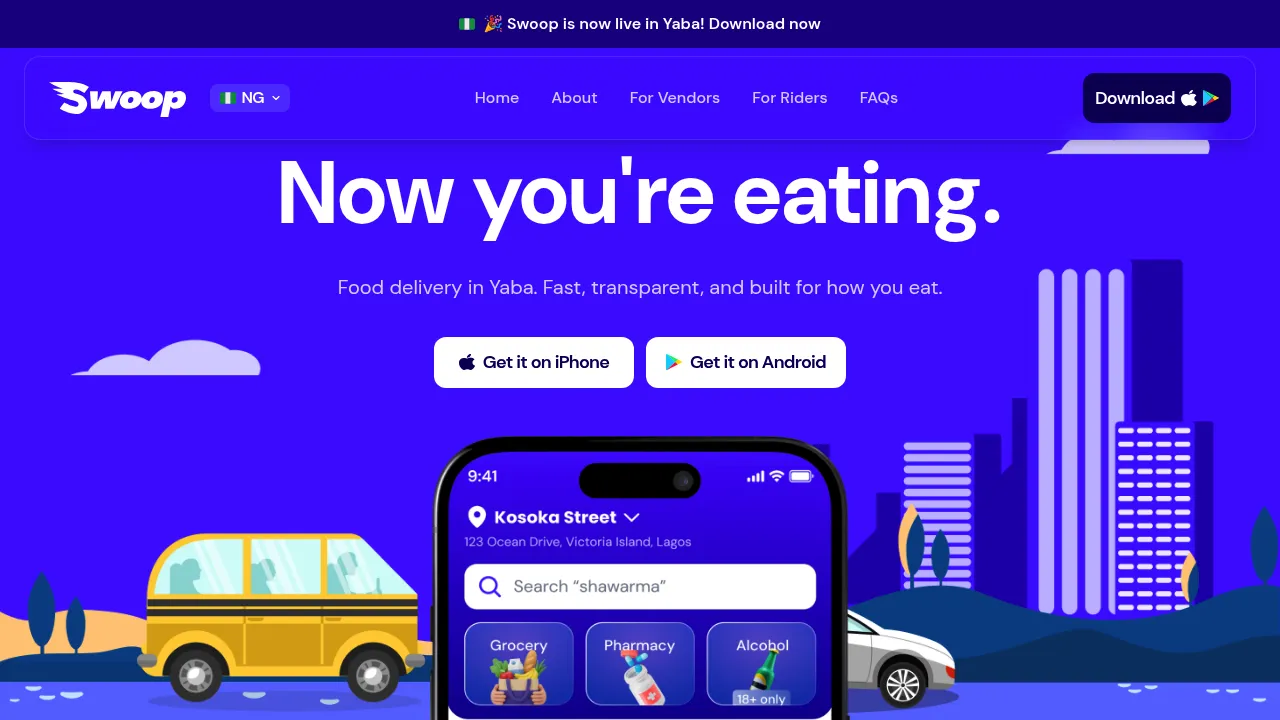
Swoop had the highest NPS in the study (+80), driven by price. 9 of its 10 orders used a promo, the median delivery fee was zero, and no rider struggled with an address. The median delivery took 32 minutes.
One tester's experience shows the gaps: OPay payment failed, the package was missing items, and the rider did not call when running late.
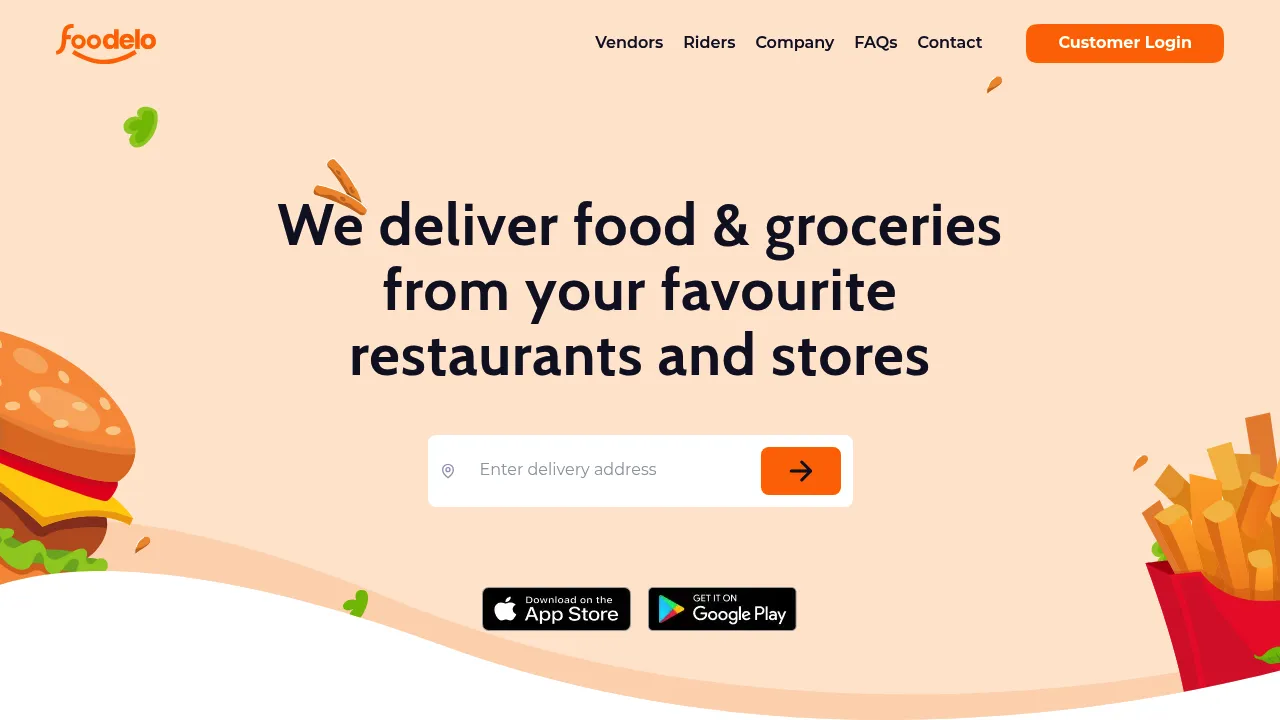
Foodelo had the best customer support in the study. Its team contacted testers about their orders without being asked, and two testers named it as the thing that impressed them most. No rider struggled with an address.
It was also the most expensive app for delivery, with a median fee of about ₦1,600. One tester's ₦4,500 meal became a bill of more than ₦8,000. Orders were slow too: 3 of 8 took more than an hour, and one tester found very few vendors near their location.
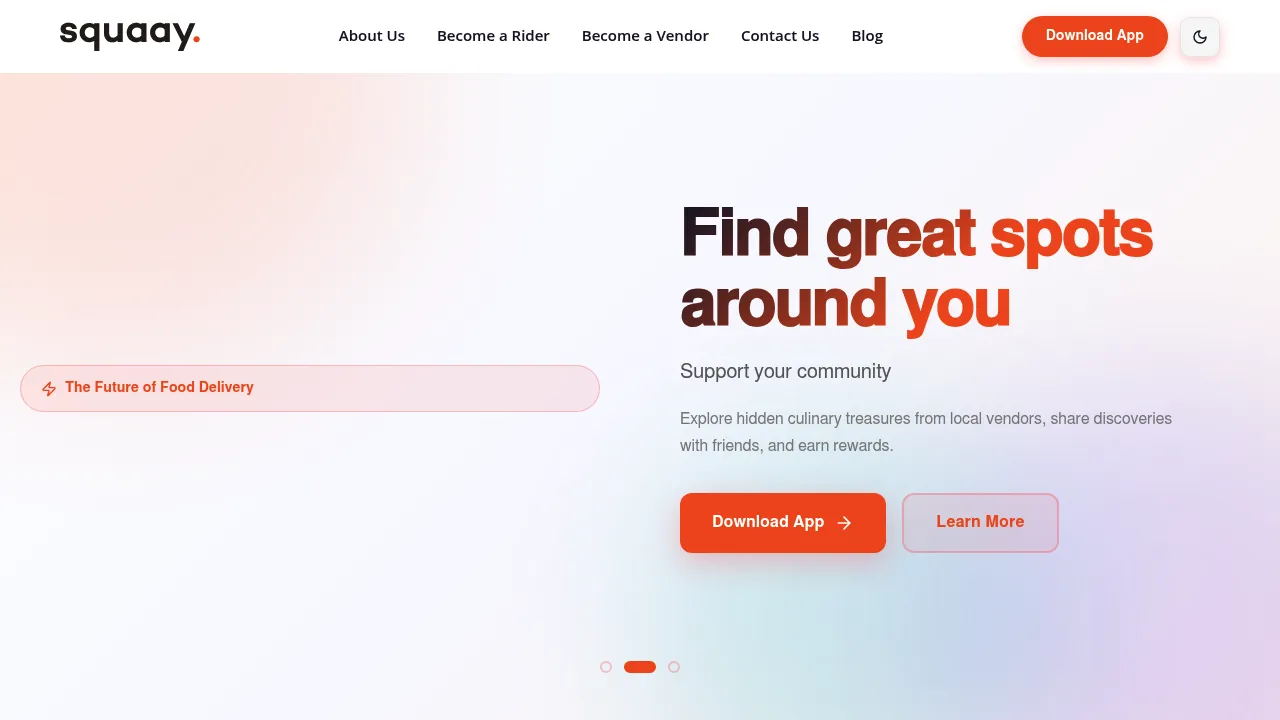
Squaay had the weakest results among the apps we could fairly compare: satisfaction 3.88, NPS -25 and a median delivery time of 60 minutes across 8 orders. Testers needed support on 62% of them.
One vendor left an order unaccepted for more than an hour. Another order took over 24 hours because the listed meal was no longer available. One tester's Refuel Max arrived without its sides, and another had to top up an order to meet a minimum. Squaay did reach out to apologise when one order ran long, which that tester appreciated.
FoodNaija's results were the weakest in the study, though based on only 7 orders. Satisfaction averaged 3.0 out of 5, 57% of riders struggled to find the address and testers needed support on 71% of orders. The median delivery took 21 minutes.
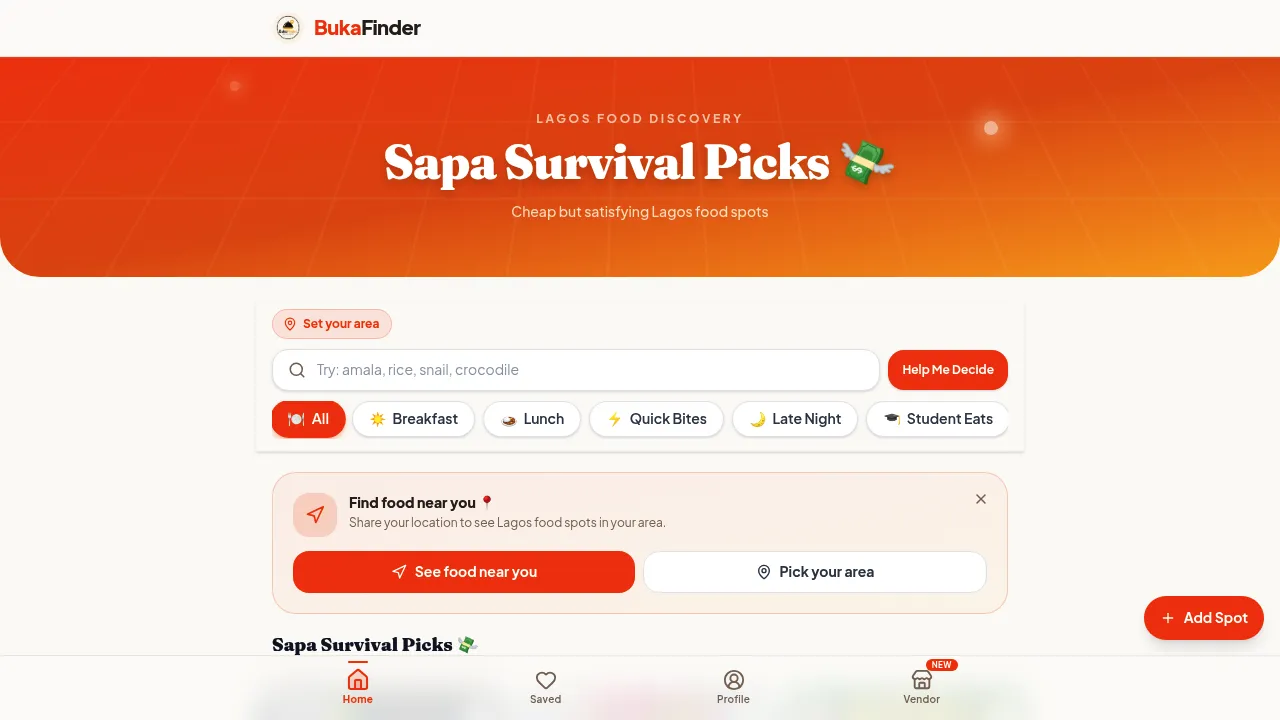
BukaFinder works differently from the other apps. One tester was redirected to a vendor on WhatsApp to see the menu, then had to agree the delivery fee with the rider directly. Testers saw the delivery fee before confirming on only 1 of 5 orders, and 40% of riders struggled with the address. Testers did say the food was worth it.
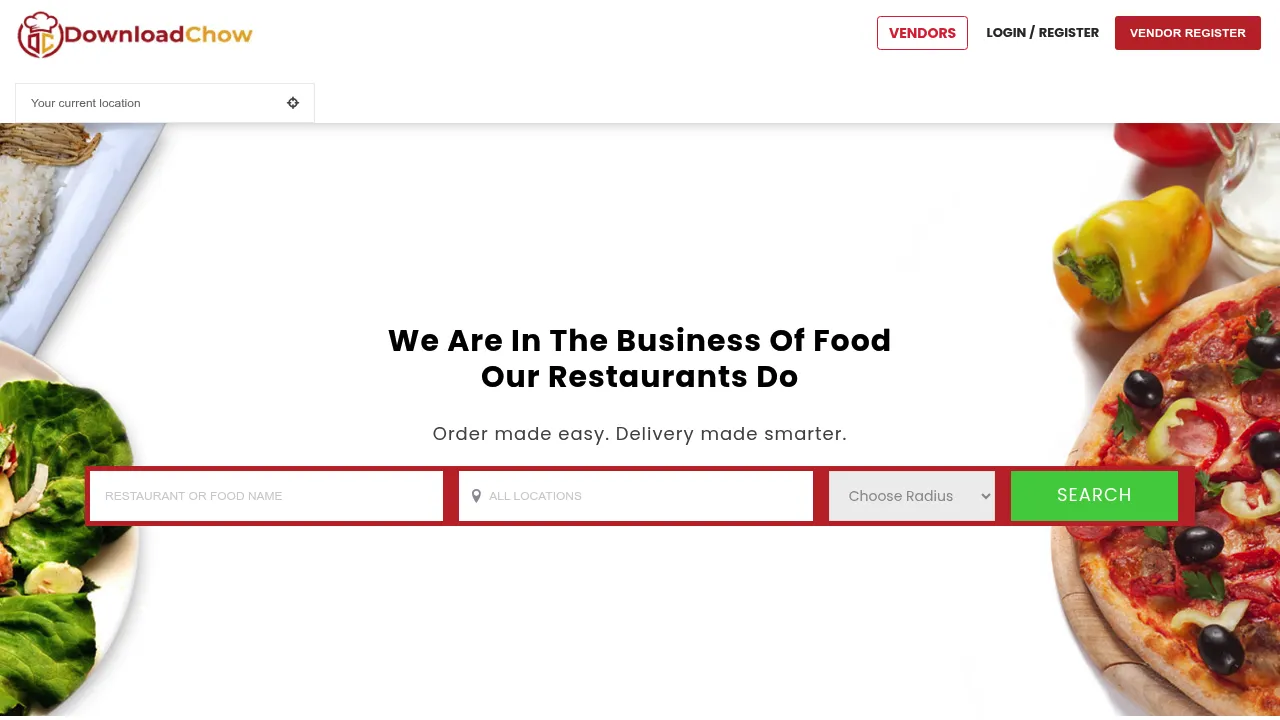
DownloadChow scored 3.40 out of 5 and an NPS of -20 across 5 orders. 60% of riders struggled with the address, and one order took about two hours. Testers liked the discount on their first delivery and the taste of the food.
The Liners research team set out to time orders. The data also showed three problems that appeared across several apps.
One in five orders had an address problem, and it was the most common failure in the study. Some came from map pins in the wrong place; others from riders who didn't read the written directions. In a country where many addresses depend on landmarks, a map pin alone is not enough.
Three Heyfood testers could not find an order reference after paying. One spelled out the risk: "There was no order reference or code, anyone could have collected my order without the rider even knowing it wasn't me." Another had to ask support for the reference after the order arrived.
Bank transfer is the most common way to pay for food in Nigeria, and it is where payments also stall. Testers saw OPay options fail, transfer accounts that would not generate and confirmations slow enough to make them fear their money was lost. 13% of orders had a payment problem, and those orders scored an NPS of -19.
Food delivery in Nigeria is fast enough for most people. Half of the orders Liners testers placed arrived within 30 minutes, 93% arrived complete, and satisfaction averaged 4.24 out of 5.
Speed is no longer what decides whether someone orders again.
What decides it is everything around the food: a rider who can find the gate, a payment that confirms straight away, and a final price that matches the menu. A rider who struggled with the address turned an NPS of +54 into -23. A missing item turned it negative too. A 10-minute delay wasn’t a deal-breaker.
If you are choosing a food delivery app, start with the comparison above. Then read each app's reviews and alternatives on Liners, or see how Chowdeck, Glovo and Swoop stack up side by side. And if you've ordered on any of these apps, leave a review on Liners; it helps the next person pick the right one for their lunch.
Compare them side by side on Liners: Chowdeck vs Glovo, Chowdeck vs Glovo vs Swoop, Chowdeck vs Swoop, Chowdeck vs Squaay, BukaFinder vs Chowdeck and 500chow vs Swoop.
Cheers!
The Liners Team
Sign in to keep reading
Create a free account to read the full study and every other Liners research report.
In our study of 125 orders, Chowdeck scored highest for satisfaction (4.74 out of 5), mostly among existing users. Glovo gave the most consistent first order, 500Chow was the fastest and Swoop was the cheapest to try thanks to free first-order delivery.
The median food delivery in our study took 30.5 minutes. Half of all orders arrived within 30 minutes, and 13% took more than an hour.
Liners testers paid a median of ₦650 on Chowdeck and ₦400 on Glovo, including promos. Across all apps, the median paid delivery fee was ₦1,000. Fees change with distance, time of day and promotions.
Swoop was cheapest to try, with free delivery on most first orders. Among apps that charged a fee, Glovo had the lowest median (₦400). 500Chow had the most orders where testers felt they paid less than going direct.
Neither clearly won. Testers who had used both mostly preferred whichever app they had just ordered from. Chowdeck scored higher on satisfaction, packaging and support among its mostly returning users; Glovo had lower fees and a steadier first order.
Yes, on some apps. 12% of orders in our study were paid in cash. Bank transfer was the most common method (60%), followed by card (18%).
Liners testers placed orders in Abuja, Ibadan, Kaduna, Port Harcourt, Kano, Enugu and Ogun as well as Lagos. Availability depends on the app and the area, so check vendor coverage before you sign up.
Contact support through the app straight away and keep your order reference and photos. In our study, support fixed the issue completely in 11 of 26 cases and not at all in 10.
One email per report. The headline finding, the sample, and a link, nothing else.
Roughly one email a month.
 Fintech
A Liners field study of 142 sign-ups across 17 virtual dollar card apps in Nigeria, from KYC and card creation to first funding.
 Your brand here — This spot is waiting for a smart brand. That could be you.
 500chow
 BukaFinder
 Chowdeck
 Dado Food
 DownloadChow
 Foodelo
 Heyfood
 Squaay
 Swoop