100% match
Shop affordable cosmetics and personal care online
/Graveyard/MallforAfrica

Cross-border shopping from US and UK retailers for Africans
Epitaph
“Here lies MallforAfrica. It let African shoppers check out from Best Buy, eBay and Macy's, did $17 million in sales in 2014 and built the engine behind DHL's Africa eShop. Then the naira wobbled, the app left the stores and the 'temporary' pause never ended.”
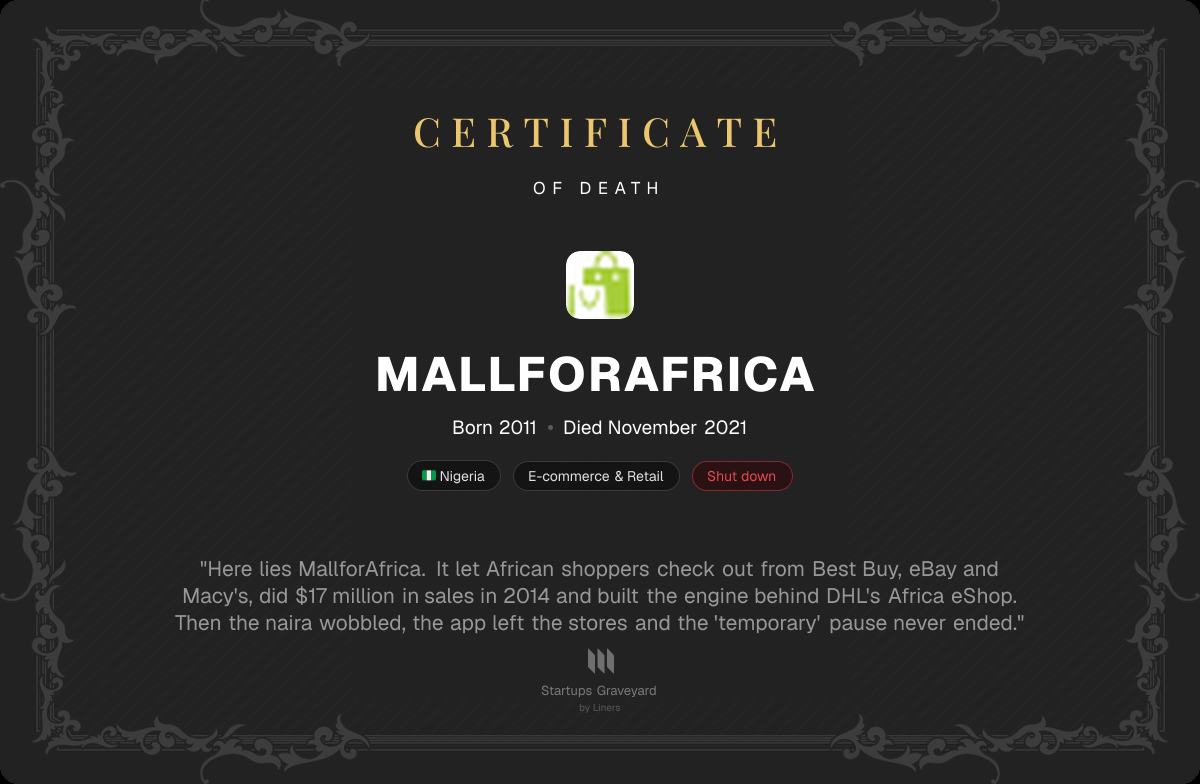
Chris and Tope Folayan founded MallforAfrica to let Africans shop from US and UK retailers (founding year varies by source).
DHL launched Africa eShop built on MallforAfrica's technology.
Techpoint reported the app removed from stores, logins disabled and orders halted, with customer care citing forex instability and CBN policies.
MallforAfrica was founded by brothers Chris and Tope Folayan (TechCrunch and the New York Times date it to 2011) to let Africans buy directly from US and UK retailers. It acted as a middleman, absorbing fraud risk and handling shipping, with partners including Best Buy, eBay, Macy's and Bloomingdale's. Fortune reported $17 million in sales in 2014. Helios Investment Partners provided growth capital in 2013, and DHL partnered with it from 2017, later launching Africa eShop on MallforAfrica's technology.
By 2021 it said it operated in four countries: Nigeria, Ghana, Kenya and Côte d'Ivoire. Filings showed liabilities exceeding assets in 2018 and 2019.
In late 2021 the app disappeared from Google Play and the App Store, users could not log in and the site stopped taking orders. Customer care blamed Nigeria's unstable exchange rate and Central Bank of Nigeria policies, and Chris Folayan called it a temporary closure with no reopening date. Techpoint reported the shutdown on 2 November 2021, a week after DHL said Africa eShop would close.
Orders placed before the closure were fulfilled through pickup centres, and the company said account balances would be refunded, more slowly than usual because of reduced staff.
MallforAfrica aimed to give African shoppers access to US and UK retailers that would not ship to them directly. It took on fraud risk and logistics, so customers could pay locally and receive goods from stores such as Best Buy, eBay, Macy's and Bloomingdale's.
The model attracted early scale and partners. Fortune reported $17 million in sales in 2014, Helios Investment Partners invested growth capital in 2013, and DHL partnered with the company from 2017. In 2019 DHL launched Africa eShop on MallforAfrica's technology, and the founders created Link Commerce to sell that technology as a service.
The business depended on customers converting naira into dollars to buy foreign goods, which tied it to Nigeria's exchange rate and Central Bank policy. Its footprint shrank from 17 countries in 2018 to four by 2020, and UK filings for the group showed liabilities exceeding assets in 2018 and 2019. Its social channels went quiet from mid 2021.
In late 2021 the app was pulled from both app stores, logins stopped working and new orders were refused. Customer care cited the unstable forex rate and CBN policies. Chris Folayan said the closure was temporary, while a Techpoint source said the brand would likely return under a new name and that investors had pulled out, which Folayan denied. DHL announced on 26 October 2021 that Africa eShop would close by the end of that month. Sources reviewed do not show MallforAfrica resuming.
Cross-border commerce priced in foreign currency is exposed to currency controls in the buyer's home market. A business whose core transaction needs hard currency should plan for FX restrictions and keep enough runway to refund customers cleanly if it has to stop.
Was this shutdown inevitable?
Be the first to weigh in
Community opinion, not Liners' editorial conclusion.
Shop affordable cosmetics and personal care online

Buy certified quasi-new iPhones with warranty in Abidjan

Shop multiple product categories with flexible payments

Shop millions of products from sellers across Africa
Help us give it a proper burial. Submit a shutdown and our researchers will verify it before it's laid to rest.
Submit a Shutdown