

/Graveyard/Afrimarket

Afrimarket
E-commerce platform for francophone West and Central Africa
Epitaph
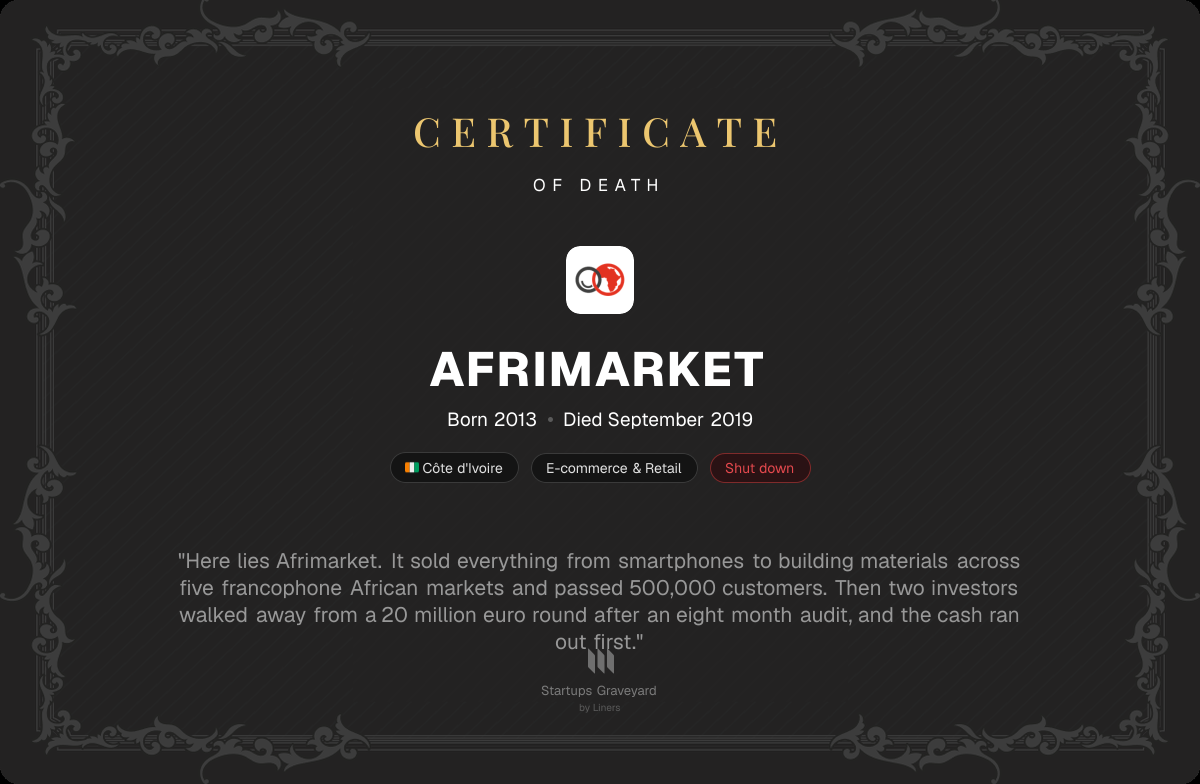
“Here lies Afrimarket. It sold everything from smartphones to building materials across five francophone African markets and passed 500,000 customers. Then two investors walked away from a 20 million euro round after an eight month audit, and the cash ran out first.”
Overview
- Born
- 2013 (Year)
- Died
- September 2019 (Month)
- Lifespan
- 7 years
- Fate
- Shut down
- Headquarters
- Côte d'Ivoire
- Category
- E-commerce & Retail
- Primary cause
- Funding or runway
- Contributing causes
- Competition, Business model or unit economics
Death certificate
Timeline
- 2013Founded
Rania Belkahia and Jeremy Stoss begin building Afrimarket, an e-commerce business for West Africa run from Paris.
- 201830 million euros in business volume
Platform business volume reaches 30 million euros, up from 250,000 euros in 2015, with more than 500,000 customers.
- September 2019Files for liquidation
After two funds withdraw from a 20 million euro round, Afrimarket asks the Paris commercial court to place it in judicial liquidation. About 250 jobs are lost.
Autopsy report
Why did Afrimarket shut down?
Afrimarket was an online retailer headquartered in Paris and focused on West and Central Africa, operating in Côte d'Ivoire, Senegal, Mali, Cameroon and Benin. It sold appliances, smartphones, building materials and groceries, and handled its own logistics down to the last mile. Rania Belkahia and Jeremy Stoss had been building it since 2013.
By 2018 business volume on the platform had reached 30 million euros, up from 250,000 euros in 2015, and the company had passed 500,000 customers. It had raised about 13.5 million euros and invested roughly 50 million euros in total including bank loans and revenue.
In 2019 Afrimarket sought a 20 million euro round. Two funds in the final stage withdrew in mid-summer 2019 after an eight month audit, and investors doubted the market could support a second large player next to Jumia, which had just listed in New York. In September 2019 the company asked the Paris commercial court to place it in judicial liquidation. About 250 people lost their jobs, around 30 of them in France.
What Afrimarket Attempted
Afrimarket set out to build a large online retailer for francophone West and Central Africa. From a Paris head office it sold appliances, smartphones, building materials and groceries in Côte d'Ivoire, Senegal, Mali, Cameroon and Benin, and ran integrated logistics through to last-mile delivery.
What Worked
Growth was real. Business volume on the platform rose from 250,000 euros in 2015 to 30 million euros in 2018. The company passed 500,000 customers, cut customer acquisition costs by a factor of eight and reached a positive gross margin, according to Les Echos.
Early Warning Signs
The model needed heavy capital. The founders had invested about 50 million euros since 2013, including bank loans and revenue, against about 13.5 million euros of equity raised. The co-founder later said the venture would have needed about ten times more money. Jumia's April 2019 New York listing, which raised close to 200 million dollars, made investors question whether a second large player could survive.
What Happened
Afrimarket spent months raising a 20 million euro round. Two funds reached the final stage and then withdrew in mid-summer 2019 after an eight month audit. Its historic investors supported it until the cash ran out. In September 2019 the company asked the Paris commercial court to open judicial liquidation. About 250 jobs were lost, around 30 of them in France. Sources do not document what happened to customer orders in progress.
What Future Founders Can Learn
Owning logistics end to end in markets with weak infrastructure multiplies the capital a retailer needs, and founders should model that need honestly from the start. A long due diligence process is not a commitment: Afrimarket had no fallback when two funds pulled out at the last stage. When one competitor becomes the default winner in investors' eyes, a challenger needs a clear differentiated position or a path to profit without more outside money.
Lessons for future builders
- Price in the full cost of running your own logistics. Afrimarket's co-founder said the business needed about ten times more capital than planned, and integrated last-mile delivery was part of that load.
- Do not run a company's survival on a single large round. Two funds withdrew after an eight month audit and Afrimarket had no fallback financing.
- When investors start to see one rival as the category winner, as happened after Jumia's 2019 listing, a challenger needs either a distinct niche or a route to profitability that does not depend on new equity.
Your verdict
Was this shutdown inevitable?
Be the first to weigh in
Community opinion, not Liners' editorial conclusion.
Sources
- Afrimarket placée en liquidation OSIRIS (Les Echos Entrepreneurs) · 13 September 2019
- E-commerce : la startup Afrimarket en liquidation judiciaire Ecomatin · 13 September 2019
- E-Commerce : Afrimarket disparait des écrans CIO Mag · 15 September 2019
Surviving Alternatives to Afrimarket
Alternatives are ranked by shared categories, features, markets, and relevance. How alternatives workSee all 9 Afrimarket alternatives
Jumia
Liners checked this listing or its product relationship to a reasonable extent. Verification is not an endorsement or product test. How verification works88% match4.2(177)
Shop millions of products from sellers across Africa


85% match
Open a free online shop and deliver orders in Nairobi


Know a product that didn't make it?
Help us give it a proper burial. Submit a shutdown and our researchers will verify it before it's laid to rest.
Submit a Shutdown