

/Graveyard/YoLa Fresh

YoLa Fresh
Connect farmers and buyers for fresher, lower-cost produce
Epitaph
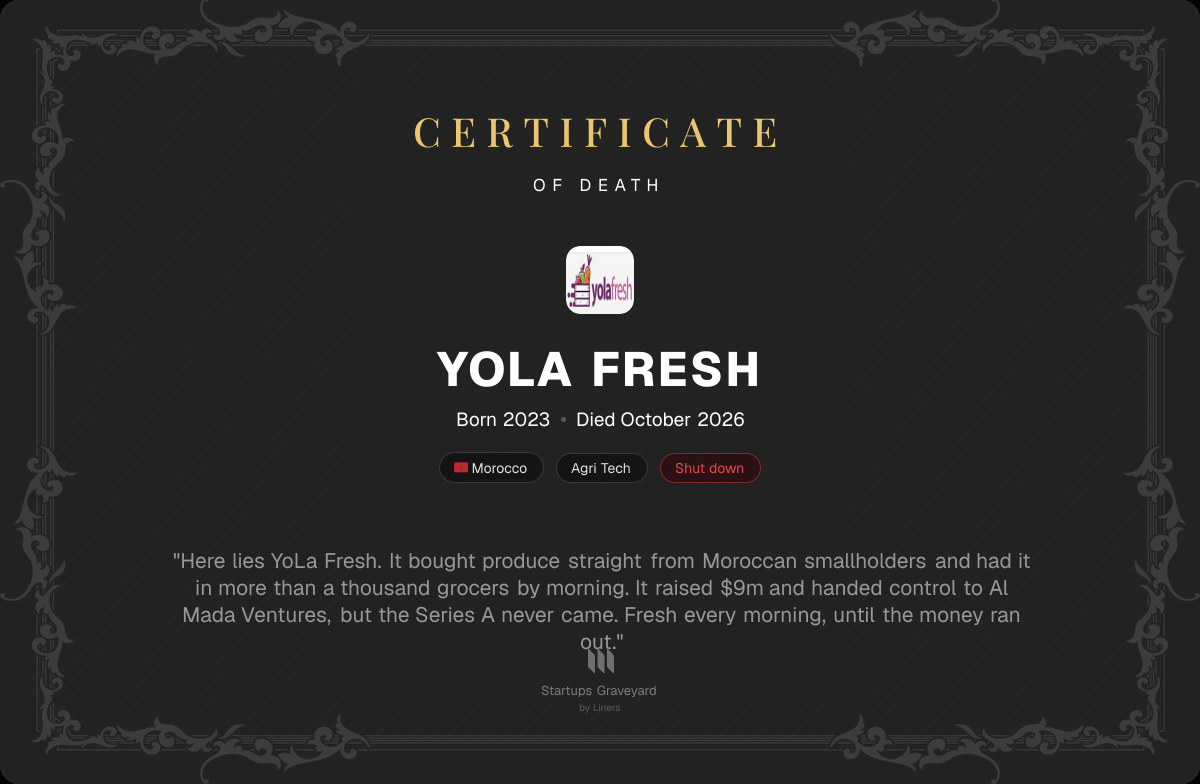
“Here lies YoLa Fresh. It bought produce straight from Moroccan smallholders and had it in more than a thousand grocers by morning. It raised $9m and handed control to Al Mada Ventures, but the Series A never came. Fresh every morning, until the money ran out.”
Overview
- Born
- 2023 (Year)
- Died
- October 2026 (Month)
- Lifespan
- 4 years
- Fate
- Shut down
- Headquarters
- Morocco
- Category
- Agri Tech
- Stage at death
- Pre-Series A
- Funding raised
- 9M
- Founders
- Larbi Belrhiti, Youssef Mamou
- Primary cause
- Funding or runway
- Contributing causes
- Business model or unit economics
Death certificate
Timeline
- 2023Two operators go back to the farm
Larbi Alaoui Belrhiti, former CEO of Jumia Morocco, and Youssef Mamou, former general manager of Careem, launch YoLa Fresh in Casablanca to connect smallholder farmers directly with traditional grocers. Mamou: "I come from an agricultural family"
- March 2023First $2m
YoLa Fresh raises a reported $2m to start building its farm-to-retailer supply chain
- 30 May 2024A $7m harvest
YoLa Fresh announces a $7m pre-Series A led by Al Mada Ventures, with Algebra Ventures, E3 Capital, Janngo Capital and FMO. It reports 1,000+ retailers, up to $1m in monthly GMV and 85% retention, and projects $40m to $50m in annualised revenue by 2026
- November 2024Al Mada takes control
Morocco's Competition Council publishes its approval of Al Mada Ventures, the investment arm of the royal family's holding company, acquiring a controlling interest in YoLa Fresh
- 9 October 2026The Series A never comes
After the closure surfaces on LinkedIn, the co-founders confirm YoLa Fresh has ceased operations because it was "unable to raise the necessary financing to pursue its development". The company and its shareholders are working with advisers on next steps
Autopsy report
Why did YoLa Fresh shut down?
YoLa Fresh was a Casablanca-based agritech company founded in early 2023 by Larbi Alaoui Belrhiti, former CEO of Jumia Morocco, and Youssef Mamou, former general manager of Careem and head of the 212 Founders incubator. It bought fruit and vegetables directly from smallholder farmers, sorted and graded them, and delivered them to traditional retailers and food-service businesses, which could order by midnight for early-morning delivery.
Within about a year it reported more than 1,000 retail customers, around $1m in monthly gross merchandise volume, roughly 1,200 tonnes moved a month and 85% customer retention. In May 2024 it raised a $7m pre-Series A round led by Al Mada Ventures, with Algebra Ventures, E3 Capital, Janngo Capital and FMO, bringing disclosed funding to about $9m after a reported $2m round in March 2023. Later in 2024, Morocco's Competition Council approved Al Mada Ventures taking a controlling interest.
In October 2026 the co-founders confirmed that YoLa Fresh had ceased operations because it was "unable to raise the necessary financing to pursue its development." They rejected reports that it had raised about $20m as inaccurate. The company and its shareholders said they were working with advisers on next steps and gave no further detail.
Why did YoLa Fresh shut down?
YoLa Fresh was a Casablanca agritech company built by two of Morocco's best-known tech operators: Larbi Alaoui Belrhiti, former CEO of Jumia Morocco and founder of Avito, and Youssef Mamou, former general manager of Careem and head of the 212 Founders incubator. Launched in early 2023, it bought fruit and vegetables directly from smallholder farmers and delivered them overnight to the traditional grocers and food-service businesses that handle most of Morocco's produce. Within about a year it reported more than 1,000 retail customers and around $1m a month in gross merchandise volume, and in May 2024 it raised a $7m pre-Series A led by Al Mada Ventures, which later took a controlling stake. In October 2026 the co-founders confirmed the company had ceased operations because it was "unable to raise the necessary financing to pursue its development." Disclosed funding totalled about $9m; the founders called reports of roughly $20m inaccurate.
What YoLa Fresh attempted
Morocco's fresh produce reaches shops through long chains of wholesalers and middlemen. Smallholders account for about 80% of agriculture and traditional retail for 90 to 95% of distribution, while post-harvest losses on fruit and vegetables can reach 20 to 40%. YoLa Fresh set out to replace that chain with a single B2B platform. Retailers ordered by midnight and received produce early the next morning, paying cash on delivery. YoLa Fresh sourced directly from farmers and handled sorting and grading, but said it did not own warehouses, trucks or inventory, and used data and AI forecasting to match supply with orders. The founders modelled it on Meicai in China, Frubana in Latin America and WayCool in India, and planned to scale across Morocco before expanding to Egypt, Kenya, Nigeria and Côte d'Ivoire, adding farmer finance and, later, branded products and its own retail outlets.
What worked
- Fast early traction. About a year after launch it reported more than 1,000 retailers, up to $1m in monthly GMV, roughly 1,200 tonnes moved a month and 20 to 30% month-on-month growth.
- Sticky customers. It reported 85% customer retention and around four orders per retailer each week.
- Less waste. It said wastage fell to about 6 to 7%, against 25 to 40% in traditional chains, with a target of 3% by 2026.
- Strong backers. Its pre-Series A brought in Al Mada Ventures, Algebra Ventures, E3 Capital, Janngo Capital and the Dutch development bank FMO.
Early warning signs
- Margins were still a target. In mid-2024 the company said it expected a positive contribution margin only by the end of 2024 or early 2025. Co-founder Larbi Alaoui Belrhiti said at the time: "We want to get our unit economics right fast."
- A thin-margin, cash-on-delivery model. Fresh produce for small grocers is a high-volume, low-margin business, and collecting cash at each drop adds working-capital and operational load.
- Ambitious projections. It projected $40m to $50m in annualised revenue by 2026, roughly three to four times its reported 2024 run rate, along with expansion into four more countries.
- Concentrated ownership. After Al Mada Ventures took control in 2024, the next round depended heavily on the appetite of a single controlling shareholder and a thin local investor base.
What happened
YoLa Fresh reportedly raised $2m in March 2023, then announced its $7m pre-Series A on 30 May 2024. In November 2024, Morocco's Competition Council published its approval of Al Mada Ventures, the investment arm of the Moroccan royal family's holding company, acquiring a controlling interest. Filings cited by Launch Base Africa put 2023 revenue at MAD 22m. The company never announced a Series A. In October 2026 the closure was first signalled on LinkedIn, and the co-founders confirmed that YoLa Fresh had stopped operating after failing to raise the financing it needed. They said the company and its shareholders were working with advisers on next steps and declined to give further detail. Launch Base Africa noted that Moroccan startups raised $128.4m in 2025, only about $40m of it from local investors, leaving a gap between seed and Series A that is hard to bridge at home.
What future founders can do differently
- Prove positive contribution margin per order and per route before raising on growth, so the next round is a bet on scale rather than on the model working.
- Plan the post-seed round around the investors who actually write Series A cheques in your market, and start those conversations well before runway gets short.
- When one investor takes control, agree in advance how the next round will be funded and what happens if outside investors do not follow.
- Win one city's unit economics before committing to multi-country expansion.
Lessons for future builders
- Traction is not a Series A story on its own. YoLa Fresh had 1,000+ retailers, about $1m in monthly GMV and 85% retention, yet still could not raise its next round. In a thin-margin category, investors want proof that each order and each delivery route makes money. Get contribution margin positive before you go back to market, not as a promise in the deck.
- Map who will write your Series A before you take the pre-Series A. Moroccan startups raised $128.4m in 2025, only about $40m of it from local investors, so the gap between seed and Series A is hard to bridge at home. Line up the regional and international funds that back your stage early, and size your runway to the time those conversations really take.
- A controlling investor is not a guaranteed next cheque. Al Mada Ventures took control of YoLa Fresh in 2024, but the company still ran out of financing two years later. When one shareholder gains control, agree up front how future rounds will be funded and what happens if outside investors will not follow.
Your verdict
Was this shutdown inevitable?
Be the first to weigh in
Community opinion, not Liners' editorial conclusion.
Sources
- Uber and Jumia Alumni Close Moroccan Agritech YoLa Fresh After Failing to Secure Series A Launch Base Africa · 9 October 2026
- Moroccan Agritech Startup YoLa Fresh Shuts Down After Failing to Secure Funding Tech In Africa · 12 October 2026
- YoLa Fresh, a GrubMarket for Morocco, digs up $7M to connect farmers with food sellers TechCrunch · 30 May 2024
- Yola Fresh banks $7m to end smallholder farmer reliance on middlemen and boost access to fair pricing AgFunderNews · 3 June 2024
- Al Mada Ventures Takes Control of Moroccan Agritech Startup Yola Fresh Launch Base Africa · 14 November 2024
- Egyptian VC firm Algebra Ventures makes Morocco entry with $7 million pre-Series A round for YoLa Fresh Launch Base Africa · 30 May 2024
Surviving Alternatives to YoLa Fresh
Alternatives are ranked by shared categories, features, markets, and relevance. How alternatives work
77% match
AI-driven poultry production tracking and forecasting




Know a product that didn't make it?
Help us give it a proper burial. Submit a shutdown and our researchers will verify it before it's laid to rest.
Submit a Shutdown