

/Graveyard/GoLemon

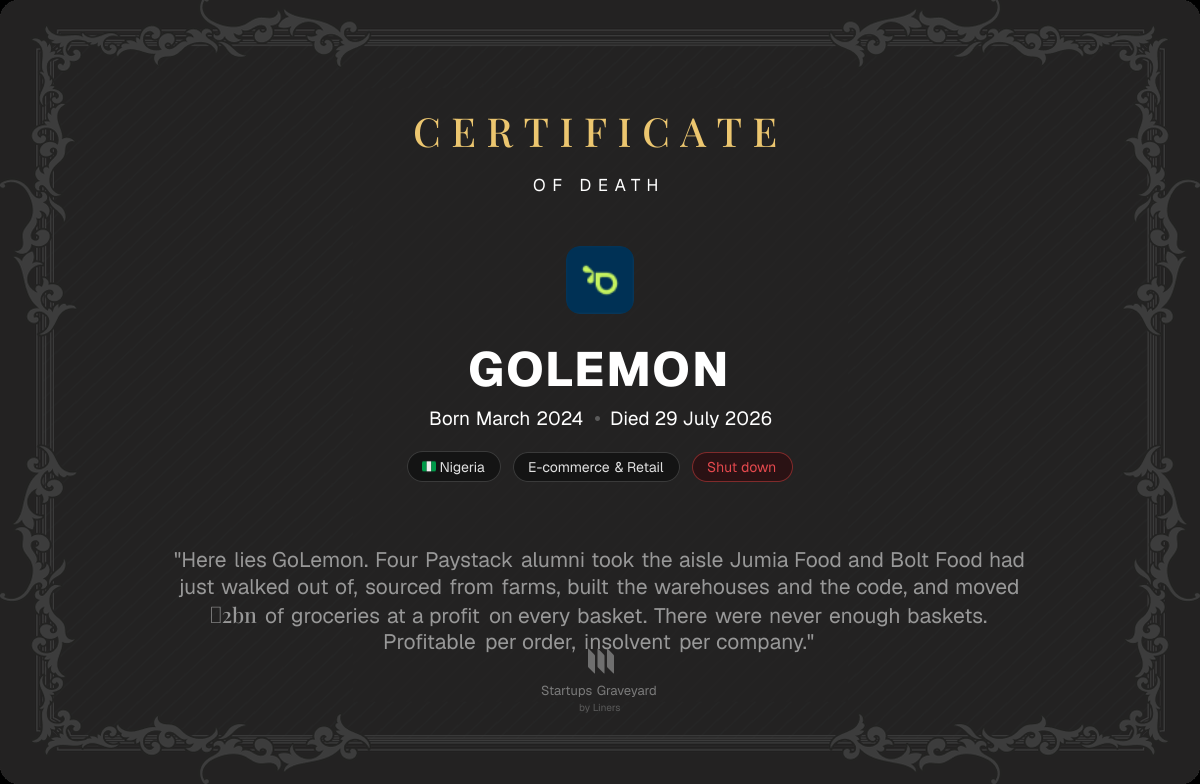
GoLemon
Order groceries and essentials with next-day delivery
Epitaph
“Here lies GoLemon. Four Paystack alumni took the aisle Jumia Food and Bolt Food had just walked out of, sourced from farms, built the warehouses and the code, and moved ₦2bn of groceries at a profit on every basket. There were never enough baskets. Profitable per order, insolvent per company.”
Overview
- Born
- March 2024 (Month)
- Died
- 29 July 2026
- Lifespan
- 2 years
- Fate
- Shut down
- Headquarters
- 🇳🇬 Nigeria
- Category
- E-commerce & Retail
- Stage at death
- Pre-Seed
- Founders
- Abdulrahman Jogbojogbo, Abiola Sphri, Yinka Adewuyi
- Primary cause
- Funding or runway
- Contributing causes
- Business model or unit economics, External shock, Competition
Death certificate
Timeline
- March 2024Four Paystack alumni open a shop
Yinka Adewuyi, Gbadegbo Gbade-Oyelakin, Abdulrahman Jogbojogbo and Abiola Showemimo launch GoLemon in Lagos, three months after Jumia Food and Bolt Food quit Nigeria. Jogbojogbo: "if we can weather the storm right now, I think we would have been able to build a formidable business"
- 17 December 2025Chowdeck comes shopping
GoLemon becomes the exclusive grocery supplier to Chowdeck's dark stores while keeping its own next-day platform. Chowdeck, with 2 million customers and a fresh $9m raise, plans 500 dark stores by the end of 2026
- 4 March 2026The sector cracks
FoodCourt switches off its app owing months of salaries and vendor debts, closing its last branch on 19 April; Eden Life pauses its consumer business the same year. Investor appetite for Nigerian food-tech thins
- 29 July 2026Out of calendar
GoLemon stops taking orders and announces it is closing after failing to complete a raise: "the timelines required to complete an investment did not align with the runway we had left"
- 2 August 2026Lights off
In-app live chat closes. Refunds are settled, suppliers paid and salaries prorated; about 20% of the 37-strong team have already found new roles
Autopsy report
Why did GoLemon shut down?
GoLemon was the Lagos grocery delivery company built by four former Paystack managers - Yinka Adewuyi (CEO), Gbadegbo Gbade-Oyelakin (CTO), Abdulrahman Jogbojogbo (growth) and Abiola Showemimo (operations) - each of whom had spent at least six years inside Nigeria's most celebrated startup exit. It launched in March 2024, months after Jumia Food and Bolt Food abandoned Nigeria, and picked the hardest version of the job: sourcing directly from farmers and manufacturers, holding inventory in its own fulfilment centres, writing its own ordering and logistics software, and running its own deliveries. It sold the planned household shop rather than the impulse single item, at an average basket of about ₦43,700 (roughly $32). By the end it had 40,000 registered customers, more than 7,000 items on the shelf, tens of thousands of deliveries and over ₦2bn (about $1.4m) of groceries moved in 28 months, with 37 staff at peak. Every one of those orders made money, the company said. There were never enough of them to cover the warehouses, the engineers and the vans, and food inflation, a weak naira and expensive diesel raised the floor faster than volume rose. In December 2025 it hedged, becoming the exclusive grocery supplier to Chowdeck's dark stores while keeping its own next-day platform. Then it went looking for another round in a market that had turned, backed by Byld Ventures, Uncovered Fund and HoaQ but having never disclosed how much it had raised. "The timelines required to complete an investment did not align with the runway we had left." On Wednesday 29 July 2026 it stopped taking orders and told customers it was closing: "Despite our efforts to raise additional funding, we couldn't find a sustainable path forward within the time available to us." In-app support stayed open until Sunday 2 August. Refunds were settled, suppliers were paid, salaries went out prorated, and about 20% of the team already had somewhere else to go.
What GoLemon attempted
GoLemon sold Lagos households their monthly shop. Four senior Paystack alumni - Yinka Adewuyi (product lead, then CEO), Gbadegbo Gbade-Oyelakin (core platforms lead, then CTO), Abdulrahman Jogbojogbo (marketing lead, then growth) and Abiola Showemimo (one of Paystack's first ten employees, then operations) - launched it in March 2024 and deliberately owned every link in the chain: buying direct from farmers and FMCG manufacturers, holding stock in its own fulfilment centres, building the customer app and the internal ordering and logistics software from scratch, and delivering with its own fleet. The pitch was not quick commerce. Where Chowdeck and Glovo raced to bring one meal in thirty minutes, GoLemon took a day or two and brought the whole trolley, betting that big planned baskets and repeat households were the only version of Nigerian grocery delivery whose maths could ever work. Jogbojogbo said at launch that GoLemon had no end-to-end competitor.
What worked
The basket thesis. Average order value settled around ₦43,700, roughly $32 and far above a food-delivery ticket, and the company says those orders were individually profitable - the thing most Nigerian delivery startups never managed. Over 28 months it served 40,000 registered customers, stocked more than 7,000 items from fresh produce to cleaning supplies, completed tens of thousands of deliveries and moved over ₦2bn (about $1.4m) in groceries, employing 37 people at peak. The timing looked like a gift: Jumia Food and Bolt Food had both quit Nigeria in December 2023, leaving the category thinly served. In December 2025 Chowdeck - 2 million customers, fresh from a $9m raise and planning 500 dark stores by the end of 2026 - signed GoLemon as its exclusive grocery supplier, validation that its supply chain was the best-built part of the business.
Early warning signs
The unit that was profitable was the order, not the company. Warehouses, engineers, vans and support are fixed costs that only get cheaper per order as orders multiply, and GoLemon's never multiplied fast enough - roughly 57,000 orders in two years works out to about 80 a day across a city of 20 million. Meanwhile the floor kept rising: food inflation at multi-decade highs, a naira that kept sliding, diesel prices that made both the cold chain and the fleet more expensive every quarter, and households with less to spend. An Android app with a little over 5,000 downloads after two years suggested acquisition was hard. The Chowdeck deal in December 2025 was reported as a growth partnership, but it also read as an admission that GoLemon's own demand channel could not fill its own warehouses. And the sector was visibly cracking: FoodCourt switched off its app on 4 March 2026 and shut its last branch on 19 April owing salaries and vendors, and Eden Life paused its consumer business the same year - exactly the news flow that makes investors stop returning calls.
What happened
GoLemon needed another round to keep buying volume, and went out to raise into a market that had turned against African consumer tech. It found interest but not a closed deal: "The timelines required to complete an investment did not align with the runway we had left." Other strategic alternatives were explored and none completed. On Wednesday 29 July 2026 the company stopped accepting orders and published its notice: "Despite our efforts to raise additional funding, we couldn't find a sustainable path forward within the time available to us." In-app live chat stayed open until Sunday 2 August 2026. The wind-down was, by the standards of this graveyard, unusually well-mannered - outstanding customer refunds resolved, no unpaid suppliers, salaries paid on a prorated basis, and roughly 20% of the team already placed in new roles with a dedicated email set up to help the rest. Its investors, Byld Ventures, Uncovered Fund and HoaQ, were named only after it died; the amounts never were.
What future founders can do differently
Contribution margin is not a business model. A profitable basket only proves the business can exist at some volume; the question that kills full-stack companies is how many baskets are needed to carry the fixed base, and whether the market will hand you that number before the money runs out. Compute the break-even order count on day one, treat it as the only metric that matters, and if reaching it requires a round you have not raised, you are not building a company - you are running a countdown. Nigeria's asset-light survivors, Chowdeck and Glovo, own no inventory and no warehouses, which is precisely why inflation and diesel hit their P&L as a rounding error rather than a death sentence. And start the raise while the story is still growth rather than survival: investor diligence takes months that a runway measured in weeks cannot lend you.
Lessons for future builders
- Profitable orders are not a profitable company. GoLemon made money on every ₦43,700 basket and still died, because roughly 80 orders a day could not carry warehouses, engineers, vans and support. Work out the break-even order count on day one and treat it as the only number that matters. If hitting it depends on a round you have not raised, you are not building a business - you are running a countdown.
- Owning the whole chain converts macro into mortality. GoLemon bought from farmers, held stock, wrote its own software and drove its own vans, so food inflation, a sliding naira and diesel prices hit its cost base directly. The Nigerian survivors, Chowdeck and Glovo, own no inventory and no warehouses, and take the same shocks as a rounding error. Own the link that is genuinely broken; rent the rest.
- Raise while the story is still growth, not survival. GoLemon found investor interest but ran out of calendar: "the timelines required to complete an investment did not align with the runway we had left." Diligence takes months a weeks-long runway cannot lend you, and a sector obituary in the news flow - FoodCourt dark, Eden Life paused - makes every one of those months longer.
Your verdict
Was this shutdown inevitable?
Be the first to weigh in
Community opinion, not Liners' editorial conclusion.
Sources
- Grocery delivery startup GoLemon shuts down after failing to raise fresh capital TechCabal · 29 July 2026
- GoLemon shuts down after 28 months and ₦2B in deliveries Technext · 29 July 2026
- GoLemon stops taking orders, as it begins winding down its Lagos grocery business Techpoint Africa · 29 July 2026
- Nigerian Grocery Delivery Startup GoLemon Announces Shutdown After Failing to Secure Additional Funding Tekedia · 29 July 2026
- After FoodCourt, GoLemon shutdown signals a reckoning for Nigeria's full-stack food tech model BusinessDay · 29 July 2026
- Four ex-Paystack managers launch GoLemon, a grocery delivery startup TechCabal · 11 March 2024
- Chowdeck taps GoLemon to supply dark stores in new instant delivery push TechCabal · 17 December 2025
- GoLemon is latest Nigerian food delivery startup to shut down Condia · 29 July 2026
- How unpaid salaries and vendor debts forced FoodCourt to pause operations TechCabal · 3 July 2026
- Nigeria's On-Demand Delivery Graveyard Claims Latest Victim Of A Model That Can't Survive WeeTracker · 30 July 2026
- Why food delivery startups keep failing in Nigeria Technext · 30 July 2026
- GoLemon company profile: funding and investors CB Insights
Surviving Alternatives to GoLemon
Alternatives are ranked by shared categories, features, markets, and relevance. How alternatives workSee all 6 GoLemon alternatives
89% match
Shop Nigerian sellers and send packages with escrow delivery

81% match
Order and track construction materials in minutes

77% match4(1)
Fresh groceries delivered from farmers and wholesalers

74% match
Shop pet essentials online with fast Nigeria-wide delivery

Know a product that didn't make it?
Help us give it a proper burial. Submit a shutdown and our researchers will verify it before it's laid to rest.
Submit a Shutdown