

/Graveyard/KOKO Networks

KOKO Networks
Smart commerce platform
Epitaph
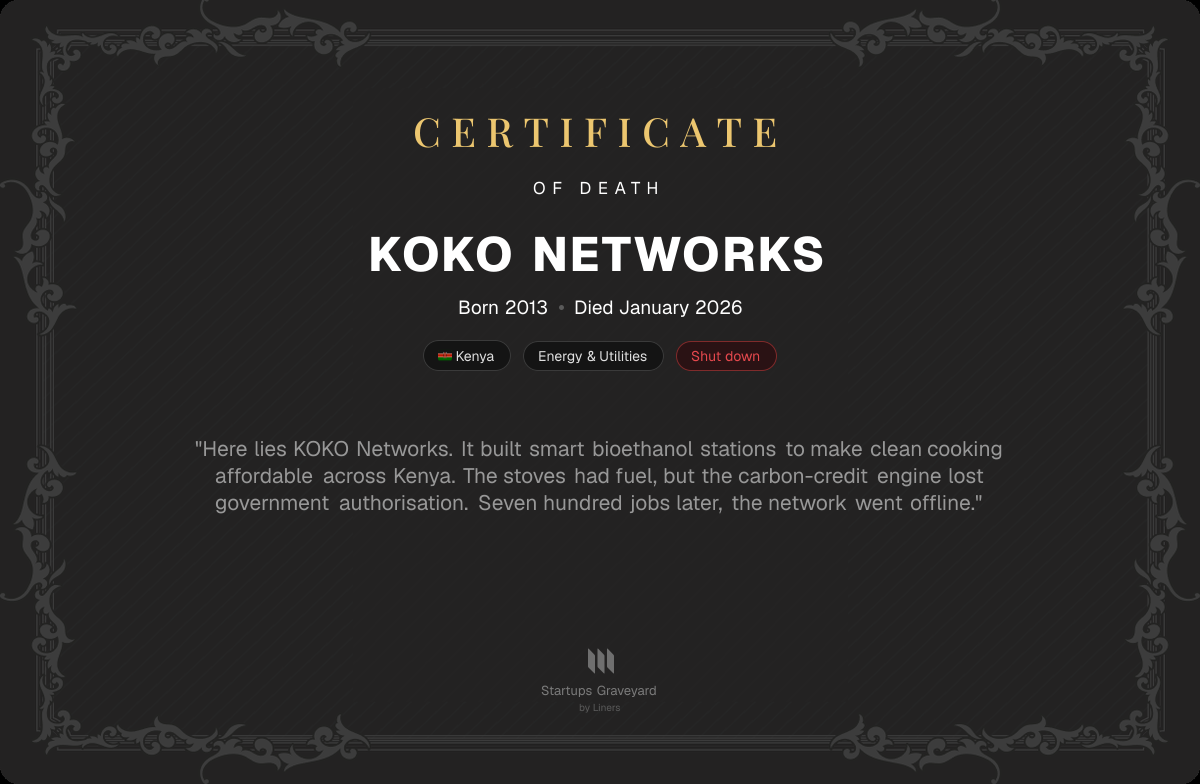
“Here lies KOKO Networks. It built smart bioethanol stations to make clean cooking affordable across Kenya. The stoves had fuel, but the carbon-credit engine lost government authorisation. Seven hundred jobs later, the network went offline.”
Overview
- Born
- 2013 (Year)
- Died
- January 2026 (Month)
- Lifespan
- 13 years
- Fate
- Shut down
- Headquarters
- 🇰🇪 Kenya
- Category
- Energy & Utilities
- Stage at death
- Growth stage
- Primary cause
- Regulation
- Contributing causes
- Business model or unit economics, Funding or runway, External shock
Death certificate
Timeline
- 2013Founding
KOKO Networks founded in Kenya to build a clean-cooking bioethanol distribution network
- April 2024Import suspension
Kenya's energy regulator suspended bio-ethanol imports, disrupting operations
- 2025Guarantee secured
KOKO secured a $179.64 million World Bank/MIGA guarantee to support expansion
- 29 January 2026LOA rejected
A senior Kenyan ministry official rejected KOKO's letter of authorisation to sell carbon credits abroad
- 31 January 2026Mass layoffs
KOKO laid off its entire 700-person workforce and ceased operations
- 1 February 2026Administration
PwC-appointed administrators took control of KOKO's assets and affairs
- July 2026Asset sale
Administrators began seeking buyers for the collapsed clean-cooking business.
Autopsy report
Why did KOKO Networks shut down?
KOKO Networks, a Kenyan clean-cooking and biofuel startup, laid off its entire 700-person workforce and ceased operations on January 30-31, 2026, after the Kenyan government rejected a letter of authorisation needed to sell carbon credits abroad, cutting off the revenue that subsidized its bioethanol and stoves. The company entered administration under PwC-appointed administrators on February 1, 2026, and by mid-2026 was being liquidated with its assets put up for sale. [graveyard-sheet-seed]
What KOKO Networks attempted
KOKO Networks built a network of automated bioethanol dispensing machines placed inside retail shops across Nairobi and other urban areas, selling subsidized clean cooking fuel and stoves to low-income households as an alternative to charcoal and kerosene, funded partly by international carbon credit sales.
What worked
The company scaled to over 3,000 automated fuel dispensers and roughly 1.5 million dependent households, and raised more than $300 million in equity, debt and guarantees (including a $179.6 million World Bank/MIGA guarantee) from investors such as Verod-Kepple, Mirova, Rand Merchant Bank and Microsoft's Climate Innovation Fund.
Early warning signs
Kenya's energy regulator suspended bio-ethanol imports in April 2024, forcing operational shifts, and customers faced recurring fuel shortages through late 2024 and 2025 while the company awaited government approval of its carbon credit authorisation.
What happened
After prolonged negotiations, a senior Kenyan ministry official rejected KOKO's letter of authorisation for carbon credit sales on January 29, 2026, eliminating the revenue that subsidized its below-market fuel and stove pricing. Management told all 700 staff not to report to work on January 31, 2026, and PwC-appointed administrators took control of the company on February 1, 2026; by mid-2026 administrators were seeking buyers for the collapsed business.
Lessons for future builders
- A subsidy-dependent network needs regulatory and revenue redundancy. Do not let one government authorization or carbon-credit channel become the switch for the entire operation.
Your verdict
Was this shutdown inevitable?
Be the first to weigh in
Community opinion, not Liners' editorial conclusion.
Sources
- The Rise & Fall of KOKO Networks: A Cautionary Tale for Kenya's & Africa's Climate Startups TechCabal · 31 January 2026
Surviving Alternatives to KOKO Networks
Alternatives are ranked by shared categories, features, markets, and relevance. How alternatives work

56% match
Pay-as-you-go LPG metering and cylinder fleet visibility


Know a product that didn't make it?
Help us give it a proper burial. Submit a shutdown and our researchers will verify it before it's laid to rest.
Submit a Shutdown