
/Graveyard/Inseco
Inseco
Nature's solution to a sustainable future.
Epitaph
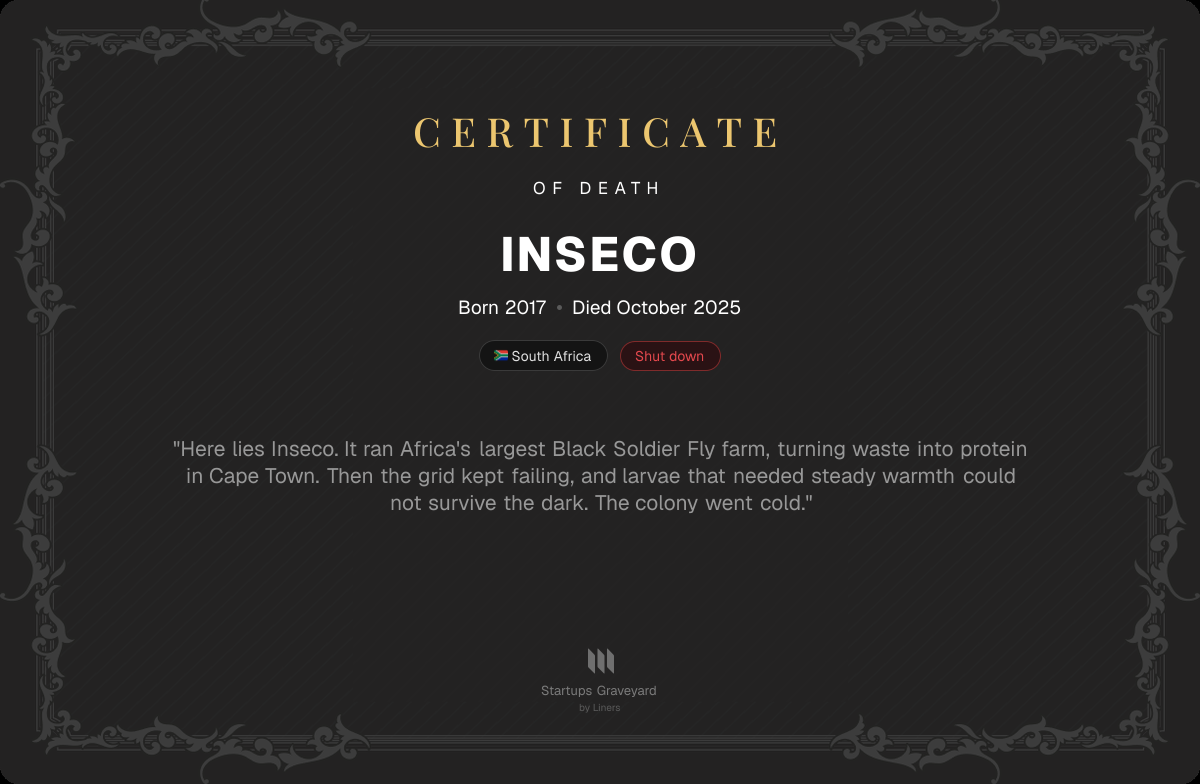
“Here lies Inseco. It ran Africa's largest Black Soldier Fly farm, turning waste into protein in Cape Town. Then the grid kept failing, and larvae that needed steady warmth could not survive the dark. The colony went cold.”
Overview
- Born
- 2017 (Year)
- Died
- October 2025 (Month)
- Lifespan
- 9 years
- Fate
- Shut down
- Headquarters
- 🇿🇦 South Africa
- Stage at death
- Seed
- Primary cause
- Infrastructure dependency
- Contributing causes
- Execution, Funding or runway, Business model or unit economics
Death certificate
Timeline
- 2022Seed round
Inseco raised $5.3 million to scale its Black Soldier Fly larvae facility
- October 2025Shutdown
Inseco ceased operations and sold its assets to industry partners, citing that it 'ran out of time.'
Autopsy report
Why did Inseco shut down?
South African insect-protein startup Inseco, which ran the largest Black Soldier Fly larvae facility in Africa, ceased operations around October 2025 and sold its assets to industry partners after intense loadshedding destabilized its biological colonies and drove up energy costs, compounding aggressive scaling, weak hiring decisions and a slow pivot amid the 2025 funding winter.
What Inseco attempted
Inseco built a 10,000 sqm insect-farming facility in Cape Town that used Black Soldier Fly larvae to convert organic waste into animal feed protein, oils and fertilizer, aiming to become a leading player in Africa's alternative-protein industry.
What worked
Inseco raised a $5.3 million seed round in 2022 to scale its Cape Town facility and became the operator of the largest insect-protein plant in Africa.
Early warning signs
Recurring multi-hour loadshedding outages escalated through mid-2025, destabilizing the temperature-sensitive larvae colonies even after backup power was installed; the company later purchased a generator but loadshedding intensity had already outpaced its contingency planning.
What happened
Inseco's facility required precise climate control that South Africa's intensifying loadshedding repeatedly disrupted, killing off insect colonies and spiking energy costs. Combined with scaling the business before reaching unit profitability, bad hires, and a slow pivot to higher-margin activities, the company ran out of capital during the 2025 funding winter and wound down, selling its assets to industry partners.
Lessons for future builders
- A business built on a fragile physical input must engineer redundancy for it, not hope. When your process depends on constant power or climate control, size backup capacity for the worst grid, and reach unit profitability before scaling the plant.
Your verdict
Was this shutdown inevitable?
Be the first to weigh in
Community opinion, not Liners' editorial conclusion.
Sources
- South African insect ag co Inseco calls it quits amid power cuts, pivots: 'We ran out of time' AgFunderNews · 15 October 2025
- South African Insect Protein Startup Inseco Shuts Down After Raising $5.3M — 'We Made Some Bad Hires' Launch Base Africa · 17 October 2025
- 'Complex Legal Structures Can Cost You': Inseco Founder's Hard Lessons from $5.3M Failure Launch Base Africa · 24 October 2025


Know a product that didn't make it?
Help us give it a proper burial. Submit a shutdown and our researchers will verify it before it's laid to rest.
Submit a Shutdown